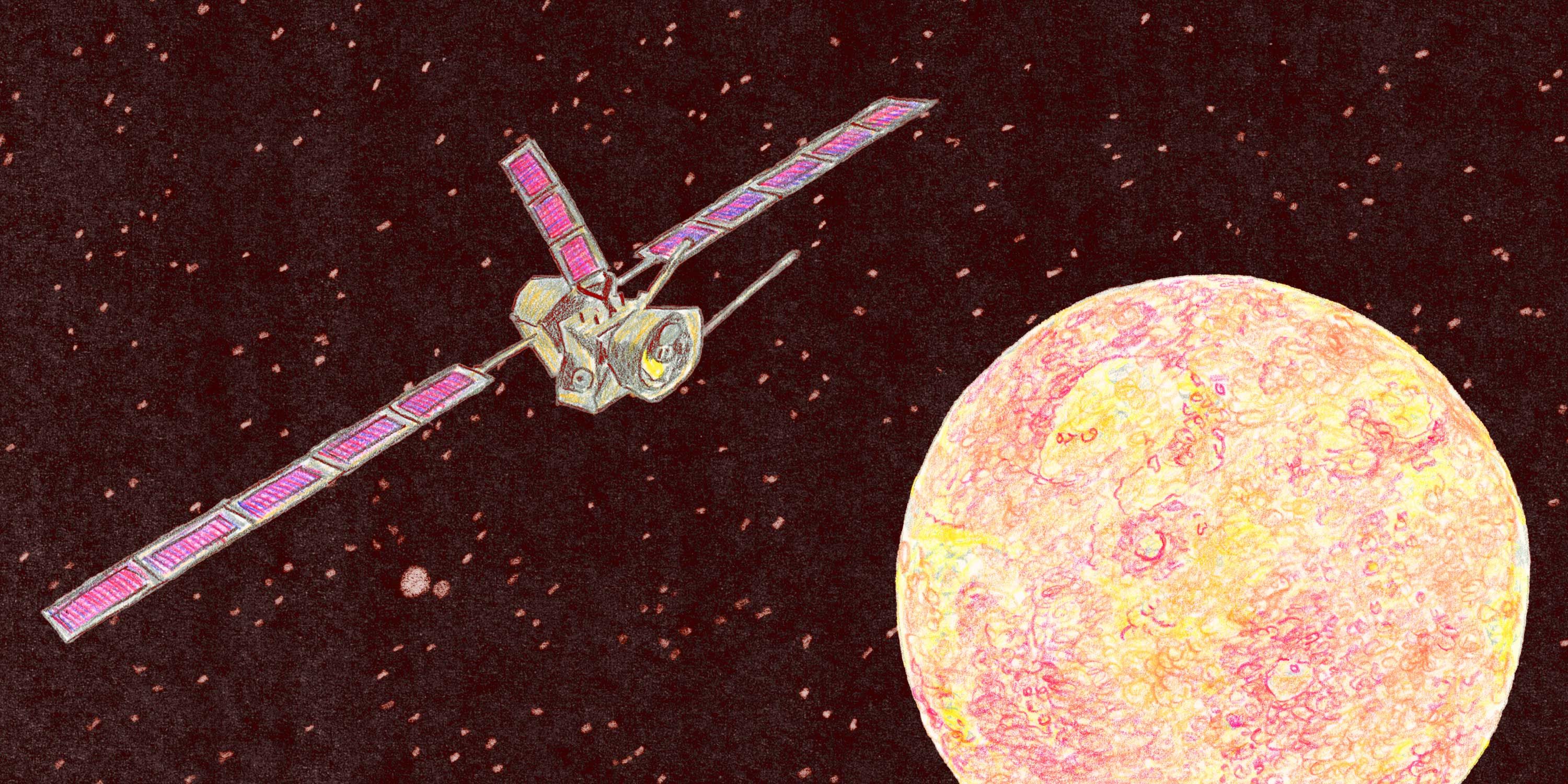
It’s probably not a good idea to go to Mercury.
It’s stupidly close to the Sun, so the sunlight there is about 11 times more intense than it is on Earth. Sure, on its nightside, this atmosphere-less world gets as cold as –290°F. But its dayside sizzles at 800°F, meaning it’s hot enough to melt lead. Anyone in their right mind would struggle to find a reason to visit this crater-covered planet sitting next to a colossal thermonuclear explosion.
Try telling that to the European Space Agency (ESA) and the Japan Aerospace Exploration Agency (JAXA). Way back in 2018, they launched an uncrewed spacecraft toward Mercury. Now, after eight long years of journeying closer to the Sun, it’s performing a series of acrobatic maneuvers to ensure Mercury’s gravity captures it. If it’s successful, it’ll then split into two separate spacecraft that will orbit the planet in different ways.
This is BepiColombo. It’s about to plunge into the fiery heart of the solar system. So much could go wrong; one or both parts of the spacecraft could catastrophically fail. “BepiColombo is an extremely challenging mission,” says Ignacio Tanco, head of the inner solar system missions unit at ESA. “The complexity associated with the things we are doing is extremely high. It’s not like other missions.”
The two-part spacecraft will eventually die in somewhat ignoble ways. But before that happens, ESA and JAXA are hoping to use BepiColombo to settle some bets about the solar system’s innermost island. “Mercury is a weirdo planet,” says Paul Byrne, a planetary scientist at the Washington University in St. Louis. And it’s a weirdo with secrets 4.6 billion years old.
Like many corners of the solar system, Mercuryis nightmarish.
From a distance, it doesn’t look that intimidating. It’s only a little bigger than Earth’s Moon, and it’s probably geologically inert, lacking in scary volcanic eruptions or major quakes. It seems to be a defenseless rocky orb that’s been mercilessly bombarded by asteroids.
Mercury’s proximity to the Sun is what makes it so menacing. It orbits our star every 88 days from an average distance of 36 million miles, which is 60 percent closer than Earth is. Any spacecraft paying it a visit must be hardened against extreme temperature spikes, as well as bursts of electronics-frying magnetized plasma.
So why go? Well, to planetary scientists, Mercury is something of an unread tome. Each of the solar system’s planets is a novel, which means that every time a spacecraft has flown to one to study it, oodles of revelations have tumbled out. What makes a place amenable to life? How do planets get their water? What goes on within the very cores of worlds? The story of the solar system can only be told in full if we read the geologic books left at each planet.
Support Supercluster
Your support makes the Astronaut Database and Launch Tracker possible, and keeps all Supercluster content free.
SupportDespite being staggeringly inhospitable, Mercury has welcomed two visitors. The first was NASA’s Mariner 10 spacecraft, which launched in 1973. This was a flyby mission, meaning it would zip past Mercury and briefly take in the sights. It was, to put it mildly, cursed: a digital demon kept resetting its flight data system and interfering with its high-gain transmission antenna. At one point, it lost sight of the star it was using to navigate through space. At another, a material purge caused it to lose flight control.
But cursed didn’t mean it was doomed. It made it to Mercury in 1974 and conducted three flybys, escaping the Sun’s fury each time, and taking a series of spectacular photographs and scientific measurements as it went. Mariner 10 later entered a graveyard orbit around the Sun, where it resides, in eternal silence, to this day.
NASA’s MESSENGER mission — specifically, the MErcury Surface, Space ENvironment, GEochemistry, and Ranging spacecraft — came next, launching in 2004. It arrived at Mercury in 2008, made a series of flybys, then entered a stable orbit in 2011. It surveyed the Mercurian surface until 2015, when its fuel supplies ran dry; it could no longer stay aloft, and it smashed into the planet.
In discovery terms, Mariner 10 was the amuse-bouche.
It told scientists that “Mercury really is an interesting place,” says Byrne. “And MESSENGER told us it was more interesting than we were expecting.”
For one thing, Mercury has an internally generated magnetic field. That’s odd, because Venus and Mars don’t — but Earth does. Earth gets its field from a churning iron-nickel outer core, which generates electricity and magnetism. No one is quite sure why Venus, being the same size as Earth, lacks one. Mars doesn’t have one because, being just one-tenth of Earth’s mass, the primordial heat deep within it — the kind needed to keep its internal iron molten and mobile — leaked out into space long ago.
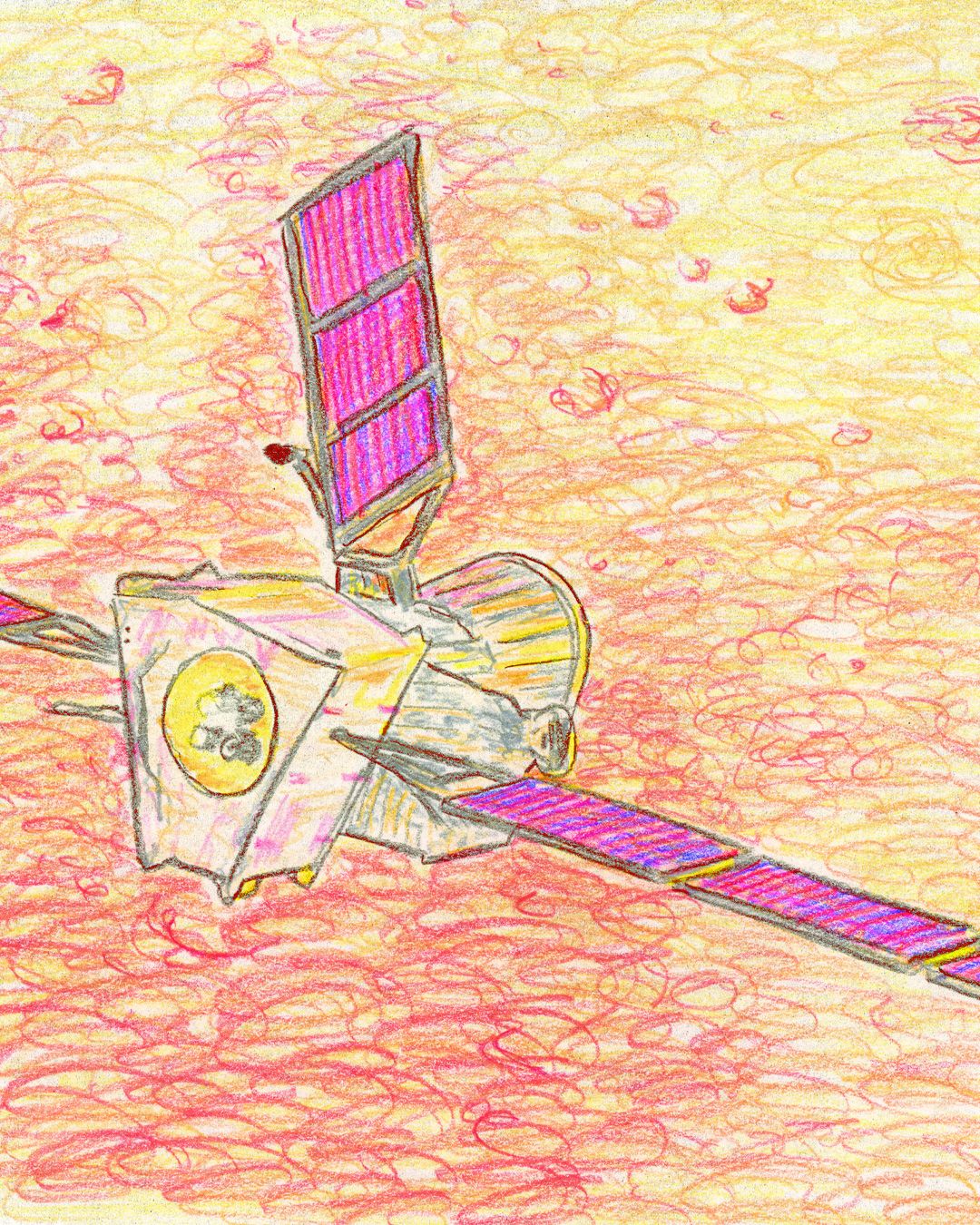
Mercury is the smallest planet in the solar system, so it shouldn’t have a magnetic field. That it does is bizarre. “What’s keeping its magnetic field going?” says Byrne. Mercury probably has a churning, iron-rich dynamo inside it, which also means it must be shockingly hot down there too. Nobody knows how this is possible.
This magnetic mystery may have something to do with another shocking discovery: Mercury’s iron core makes up 60 percent of the planet’s entire volume. For comparison, Earth’s own core comes in at roughly 15 percent. “That’s crazy,” says Byrne. And no model of planet formation convincingly explains how this could have happened. One particularly dramatic idea is that Mercury once had a larger rocky shell around its core — meaning it was a far bigger planet — but a series of cataclysmic impacts stripped most of that shell away.
Lastly, despite being the Sun’s neighbor, there appears to be frozen water and other iced-up compounds on Mercury. Although most of its surface gets scalded by sunlight, there are a few craters on its poles that effectively never see the Sun, meaning they are kept cold year-round.
“There are quite a few questions needing to be answered about why Mercury’s the way it is,” says Tanco. That’s where the $2 billion BepiColombo — named after an Italian mathematician and engineer who had a fascination with the solar system’s swiftest planet — comes in.
BepiColombo is a little unusual, in that it was designed to break apart at different stages. Generally speaking, you don’t want your spacecraft to split into pieces, but that’s a feature here, not a bug.
The first component is ESA’s Mercury Planetary Orbiter, or MPO, armed with 11 instruments that will survey the world’s surface and interior. The second is the Mercury Magnetospheric Orbiter, or MMO — affectionately nicknamed Mio by JAXA. Mio is chiefly designed to study Mercury’s magnetic field and space environment. The third is the Mercury Transfer Module, or MTM — an ESA propulsion system that was designed to take BepiColombo all the way to its destination.
None of that would mean anything if the spacecraft couldn’t withstand the terrible heat around Mercury. Fortunately, ESA and JAXA have multiple anti-solar defenses built into the spacecraft’s construction. Much of the spacecraft is painted in an atypical pale shade to reflect as much sunlight as possible. “It’s a beautiful white satellite; I love that,” says Tanco. Mio, which is slighter and more vulnerable in some ways than MPO, is also armed with a shiny sunshield that will give it some extra protection from intense solar radiation.
BepiColombo launched on October 20th, 2018. After making a few slingshots around Earth and Venus to adjust its trajectory, it began to make a series of flybys of Mercury in late 2021. This past September, it put Mercury square in its sights. Having done its job admirably, the MTM propulsion unit was detached from the spacecraft.
The MTM separation was a big deal for the mission. Now comes the hard part: get into orbit around Mercury, which the spacecraft will attempt to do in late November. There is no guarantee it will succeed; spacecraft can, and have, missed their targets to fatal effect. “We are in a tunnel,” says Tanco. “We want to get out before the train arrives.”
If BepiColombo is ensnared by Mercury’s gravity, mission operators will command the spacecraft to split apart, sending Mio out on a different orbital trajectory to MPO. Sometime just before Christmas, MPO will jettison the defunct sunshield, and over the next few weeks, both Mio and MPO will enter their own, very different, orbits of Mercury.
The dayside surface of Mercury is unfathomably hot.
But a spacecraft that never touches it isn’t free from harm, because much of that heat radiates into space. Like a person standing dangerously close to a raging bonfire, a spacecraft spending too much time near Mercury will get cooked.
To avoid that fate, Mio has a very eccentric, elliptical orbit of Mercury. This lets it study the planet’s space environment while giving it sufficient time away from its blazing surface, which allows it to cool back down and stop it from overheating. Conversely, MPO — keen to map Mercury’s surface — must orbit very close to Mercury. Its white, reflective surface sits atop multiple ceramic and aluminum layers that will insulate its electronics from the scorching-hot environment. Additionally, a back radiator continuously vents excess heat into space.
If all goes according to this somewhat baroque plan, both spacecraft will be ready to begin their science operations in early 2027. They are built to last for at least a single year, but the hope is that they persist through this cosmic hell for far longer.
At some stage, both will perish. Mio’s orbit will eventually degrade, and it will probably share the same destiny as MESSENGER: it will crash into the planet. MPO’s orbit is more stable, so it should avoid a similar collision. But the dayside blast furnace will eventually fry its electronics. “At some point, it will start not working,” says Tanco.
The immediate legacy of a triumphant BepiColombo mission will be that “we will know Mercury quite well,” says Byrne. Perhaps scientists will finally know why it has a magnetic field and a tremendously oversized iron core. In doing so, they may find out something surprising about the planet-making material that swirled around the young Sun billions of years ago.
But if more clues are required, Byrne and some of his colleagues have an ambitious suggestion. “The next natural obvious thing to do for Mercury is a lander,” he says. This robot would live a short, storied life. It would land on Mercury’s nightside and quickly deploy its instruments — which crucially include a seismometer, which can make a map of Mercury’s geologic underworld.
After a few weeks, the Sun would rise and shine on the lander. At that point, says Byrne, “it would explode.” What a charming planet.