“I think it’s like a big wedding,” I told friends recently.
They wanted to know how it felt to be a freelance reporter going to NASA’s Kennedy Space Center in Florida, to see the first astronaut moon launch in more than 50 years.
The Artemis 2 launch includes travel, tickets, guests, and vendors, I explained, but the big difference is the moving deadline. That gets fun when trying to fly a few thousand miles to the launch site — between snowstorms.
My friends — university buddies from a space degree — expressed a little concern about stress. “I’m fine,” I assured them. It’s exciting! If there’s unpredictability in planning, it’s all for good reason. On-site at an actual moon mission with astronauts, what really matters is getting four humans off the ground, to literal space, hopefully around the moon, and safely home again.
“The rest is a party,” I concluded. And the way I deal with parties is a lot of planning. In order: shoveling, writing, and making checklists. There was plenty of snow to shovel as the possible February 8th launch date approached. My mindset alternates between readiness and being acutely conscious of the responsibility of covering a historic lunar mission.
Reid Wiseman (NASA), Victor Glover (NASA), Christina Koch (NASA), and the Canadian Space Agency’s (CSA) Jeremy Hansen are set to join a very small club of pioneering explorers who have journeyed to the Moon. I met Hansen the moment he became an astronaut candidate, nearly 17 years ago, and have watched his career ever since. We never could have predicted he’d climb moonward. But so it goes.
Entering Space
My entry point to space in 1996 was simple. On the second-last day of school in junior high (“middle school”, we called it), my school’s office broadcast Apollo 13 from a VHS player to connected televisions in every classroom. The film is based on a real-life moon mission in 1970. I saw the movie’s last half-hour, from reentry to splashdown, and felt compelled to learn more.
I rented the movie at Blockbuster (RIP) to see the whole thing. A few visits to the library later—as we had no Internet at home way back then — I was diving into a new obsession: U.S. and Canadian space history. I didn’t know it then, but it put me on the path to eventually writing about space and history for a living.
While I focused my early reading on Apollo (indeed, the Apollo 13 movie posters are still on my office wall today), the greater lesson I learned was that Canada and the U.S. have been collaborating in space for a long time.
A few Canadian supersonic jet engineers on the Avro Arrow worked at NASA, including Apollo, after Arrow was cancelled in 1959. Alouette, Canada’s first satellite in 1962, flew to space on a U.S. rocket. The lunar lander bringing Neil Armstrong and others near or to the moon (1969-72) had Canadian “legs” manufactured by the company now known as Héroux-Devtek. Canadarm, the robotic space arm series now managed by MDA Space, first reached orbit with the shuttle in 1981. Its performance impressed NASA so much that the agency invited Canada to select astronauts. (They made at least two invitations, which is a long story). Our first astronaut in space was Marc Garneau in 1984. In classic “Canada is too small” fashion, about 20 years after his first mission, Garneau ended up being my chancellor at Carleton University while I studied journalism.
In May 2009, Canada selected its first two astronauts in 17 years.
It turned out one of them was a Royal Canadian Air Force fighter pilot named Jeremy Hansen, and the announcement was in my hometown of Ottawa.
I convinced my business newspaper to send me on assignment to the announcement, with a story angle focused on the Canadian space industry. On site at the local science museum, Hansen and new astro-colleague David Saint-Jacques were absolutely swarmed by television cameras and insistent reporters. I couldn’t even see the astronaut candidates from six feet away. It was like a scene out of The Right Stuff. Unfortunately, however, it’s not all that often that Canadians have space at the forefront of our national conversations.
Canada’s government flies few people in space because we’re a small population with a small tax base. Our robotic contributions, though well-appreciated, constitute roughly 2% of the International Space Station (ISS) partnership. At today’s launch rate, we send someone up there about every six years. (There are Canadians who flew to space with NASA or on private missions, but that’s a different story.)
Despite our slow launch rate, I made it a point to keep going to CSA events in between the missions. I cared, and I felt that as taxpayers, Canadians should also care. Most of these visits were press conferences and school events, but a favourite moment was in 2014: A Hansen vs. Saint-Jacques “amazing race” through Toronto, with touchpoints at Canadian space companies. The team I followed, led by Hansen, lost the race — but he was gracious in defeat. Those of us in the Canadian space community have always known him as gracious and patient.
Hansen has been on the ground for all ~17 years of his CSA service. And he served as an example of how an astronaut, even one waiting a long time for a spaceflight, always is on some kind of mission — even on Earth. He played roles supporting Chris Hadfield and David Saint-Jacques, who flew to space from Kazakhstan in 2012 and 2018, respectively. He managed the training schedule for an entire class of astronauts, both American and Canadian, from about 2017 to 2020. He nudged space policy-makers. He promoted Canada as a space partner. He was in many Mission Control voice loops as CapCom; on one mission, he talked astronauts through tricky dark-matter-detector repair spacewalks using tools he helped develop on the ground.
Then Canada made a stunning move in 2019, committing a new generation of Canadarm to NASA’s lunar space station (today called Gateway). By virtue of our early signature on the Artemis Accords, Canada would get a seat on its first crewed moon mission. Coincidentally, I joined the staff at a space publication just months before the 2023 Artemis 2 crew announcement in Houston, and the company asked me to go.
NASA held the event in an airplane hangar at Ellington, near Johnson Space Center. Standing nearby Hansen to see his name being called remains one of my top moments as a Canadian and a space geek. At last, here was my generation’s Apollo. I very much planned on being there on launch day when Hansen took that “small step” into space on behalf of our country.
The Press Site
Canadian reporters realize how fortunate we are to be accredited at Kennedy Space Center for this particular mission. Not everyone who applied for accreditation got in. We also had tickets to the rollout of the rocket, but weather and scheduling proved too tricky for my Canadian reporter friends. This meant I was the only Canadian journalist on site to see the rocket head for the launch pad. (I took comfort that at least one other Canadian was in the NASA Social group on site, however.)
Kennedy has changed a lot over the years, I realized during my visit, since I first saw STS-129’s Atlantis punch skyward in 2009. There used to be missions a few times a year, and now the Space Coast often has SpaceX Starlinks going up every couple of days. Conversations about international space partnerships, NASA’s budget, and foreign nationals have changed. That said, there was the comfort of the familiar: mostly being with my U.S. reporter friends, and the routine of working alongside them on the press site to deliver the best stories we could.
Delivering well meant a very early wakeup on rollout day, January 17th. The bus for foreign nationals left an assigned parking lot at 4:30 AM, which meant I wanted to be there 40 minutes beforehand. Fueled on cereal and granola bars, I stepped into the odd Floridian cold. That alone woke me up. When I arrived at the press site, the next thing was to choose a spot in an assigned area near the rollout zone, marked by yellow tape. Different tiers of folks had different zones; I was, naturally, with the reporters.
We waited, and we chatted, and we mostly tried to stay warm through the early morning.
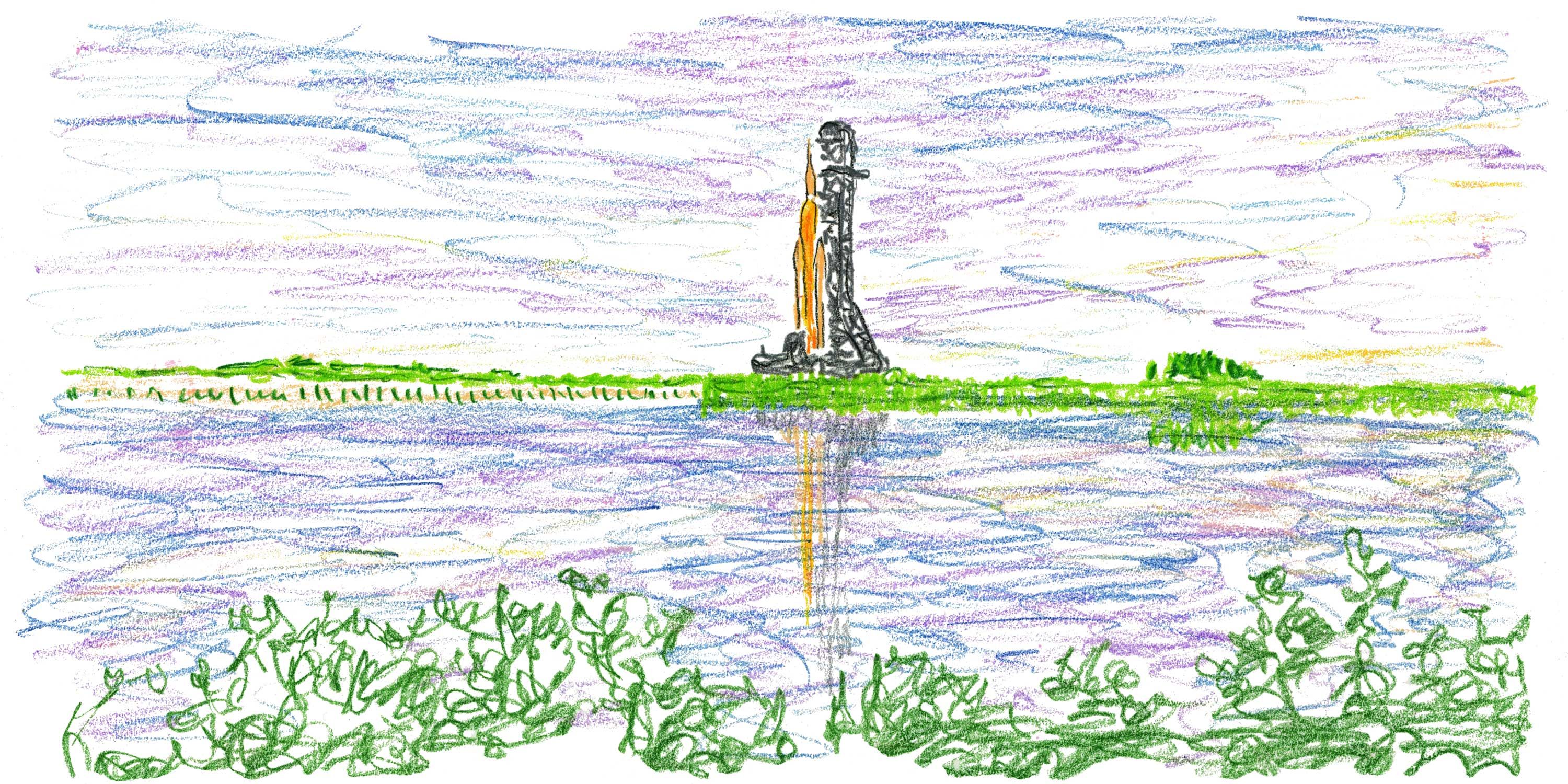
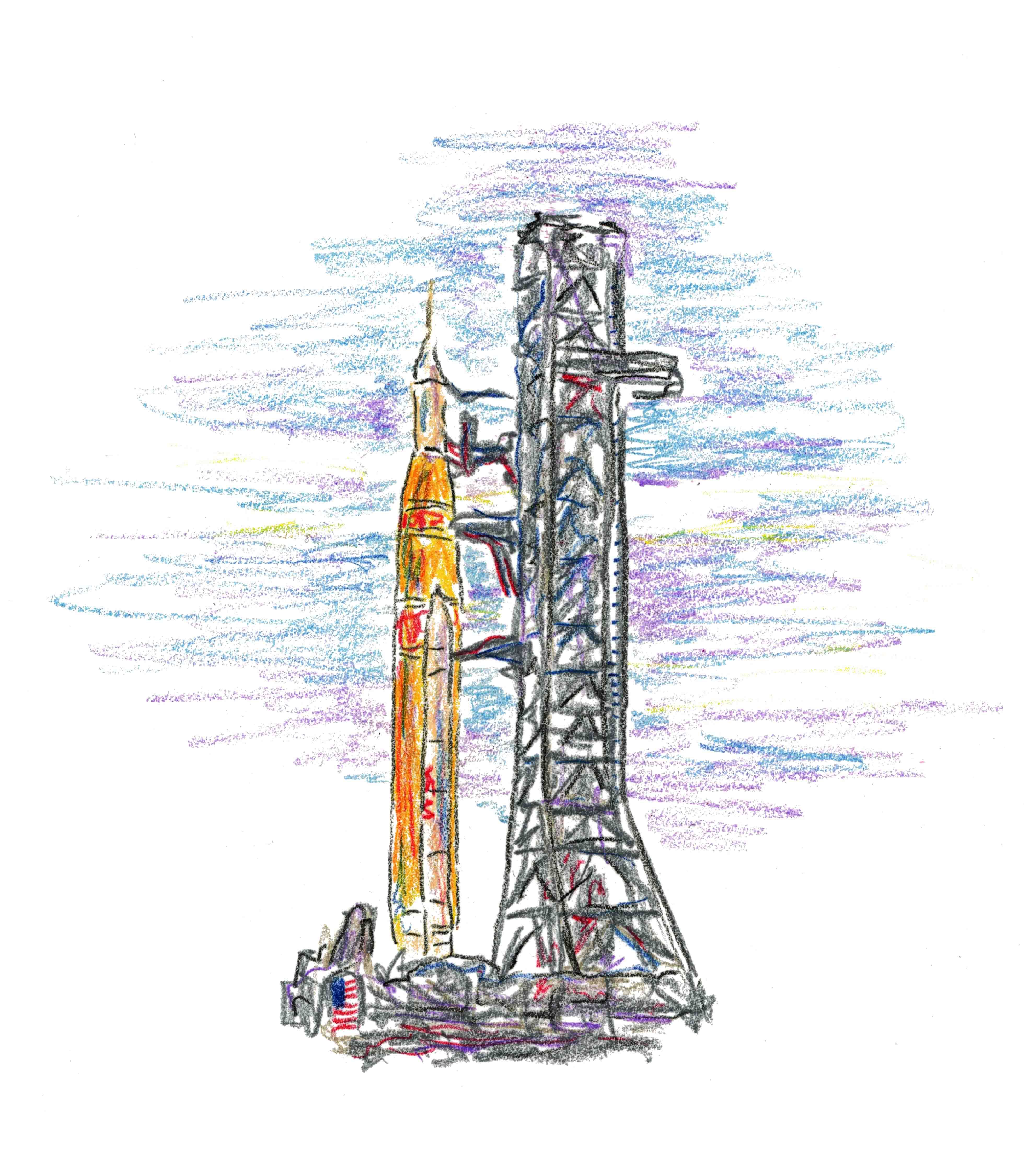
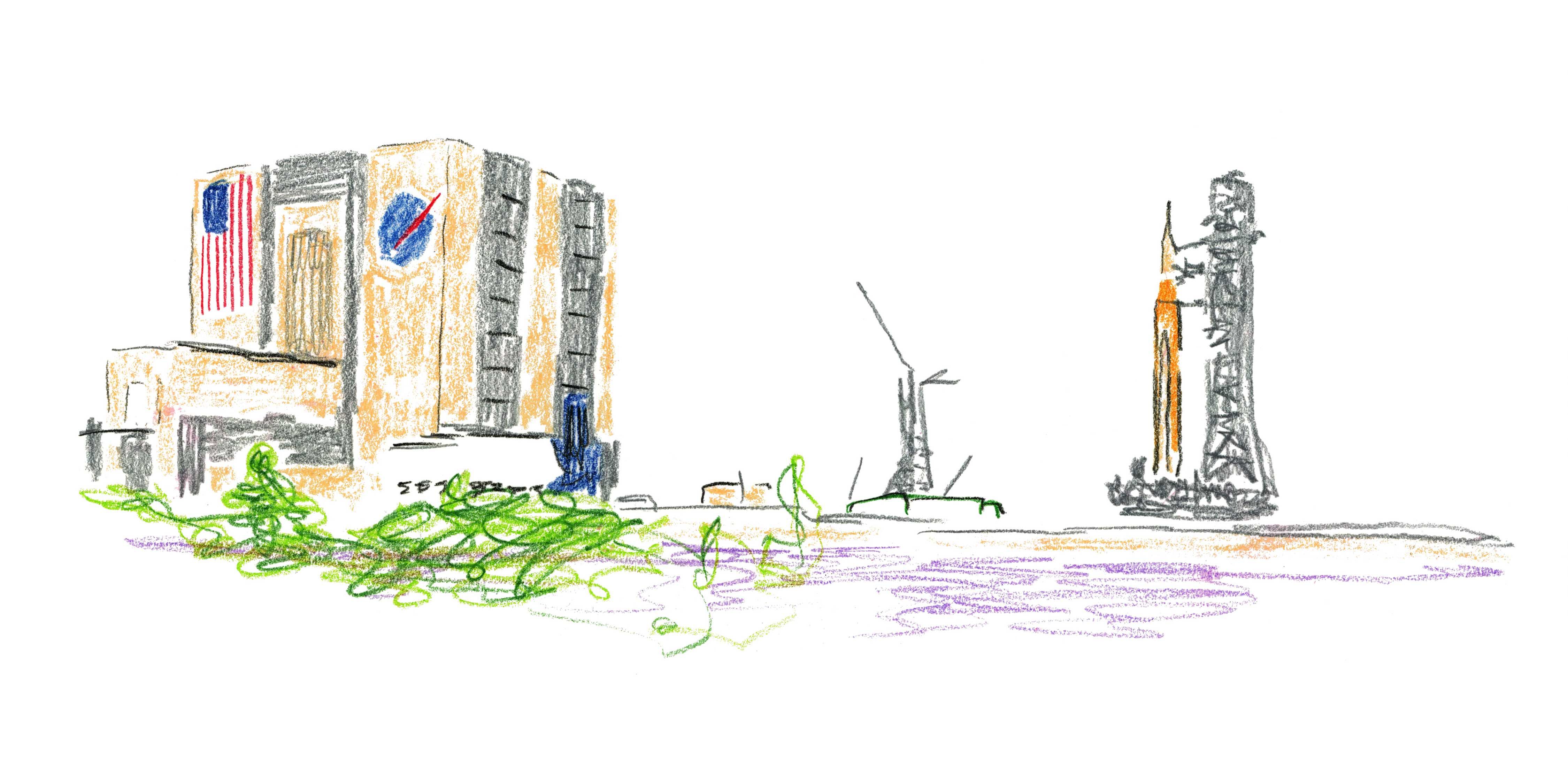
At last came the rollout I waited 30 years for, at 7:01 AM, the gigantic Vehicle Assembly Building (VAB) doors were open beforehand, but bit by bit came the rocket. Along with the launch tower, the iconic crawler-transporter of Apollo slowly brought the Space Launch System outside. The scaffolding came first, with the orange core stage coming next in the creep past the doors. The bright orange finally showed up as the sky turned blue. Then I spotted the white solid rocket boosters. My mind couldn’t grasp the size; at first, I perceived the rocket as a Lego model, but the tiny employees in the distance, by the building, told me otherwise.
The best (and worst) thing about working launch events at NASA is you often have to choose between at least two very good things happening at the same time. In my case, I wanted to linger beside that rocket to see it roll out from up close. Just a little further up the road, and I would have been almost as close as the viewpoint shown in Apollo 13. But a longtime KSC reporter-friend beside me advised that if we wanted a spot at the press conference, we should probably get going an hour before it started.
If Canada was going to be brought up during the press conference, I was likely the only shot. So I asked a question, Hansen answered, and I found peace watching the crew speak as the rocket receded in the distance.
Canadian Continuum
I am only one voice in a larger conversation, a larger continuum, of Canadian space reporters who are working today — and some before me who worked during Apollo and shuttle who have unfortunately passed on. I want to say a few of those names here because they were my friends and mentors, and incredibly good at their jobs. I wish they were able to watch us fly lunarside: Lydia Dotto. Peter Calamai. Peter Rakobowchuk.
Support Supercluster
Your support makes the Astronaut Database and Launch Tracker possible, and keeps all Supercluster content free.
SupportTo the best of my knowledge, we don’t have a wall of prominent space reporters in Canada, as KSC’s press site does. But when I looked at the KSC names later that day, I thought of my Canadian reporter friends, and the newer generation of social media specialists and influencers who are doing great things, too.

My question to Hansen had essentially been about what we, as a country, should do next in space after the moon. He, in part, answered that it’s up to the international partnership. With the Artemis II launch date now shifting to March, I hope my Canadian reporter friends with press site accreditation will actually get to see Hansen fly. We live far away, and you never know with rockets. And weather. But Canadians and Canadian residents, even as minority partners, paid for Hansen’s seat.
A few of us should be at KSC to bear witness.
....
Elizabeth Howell is a freelance space reporter and editor in Ottawa, Canada. For play-by-play Artemis 2 mission events at KSC, she is representing Canadian trade magazine SpaceQ, where she serves as associate editor.