Astronaut candidates have about two years to get used to NASA training before they are fully certified as astronauts.
HOUSTON - As part of the run-up to the SpaceX Crew-13 launch, which includes Canadian Space Agency astronaut Josh Kutryk, media from Canada like myself received an exclusive tour of NASA’s Johnson Space Center on August 5th — everything from seeing a dark-matter detector spacewalk training run in a pool, to talking about spacesuit leaks at Mission Control.
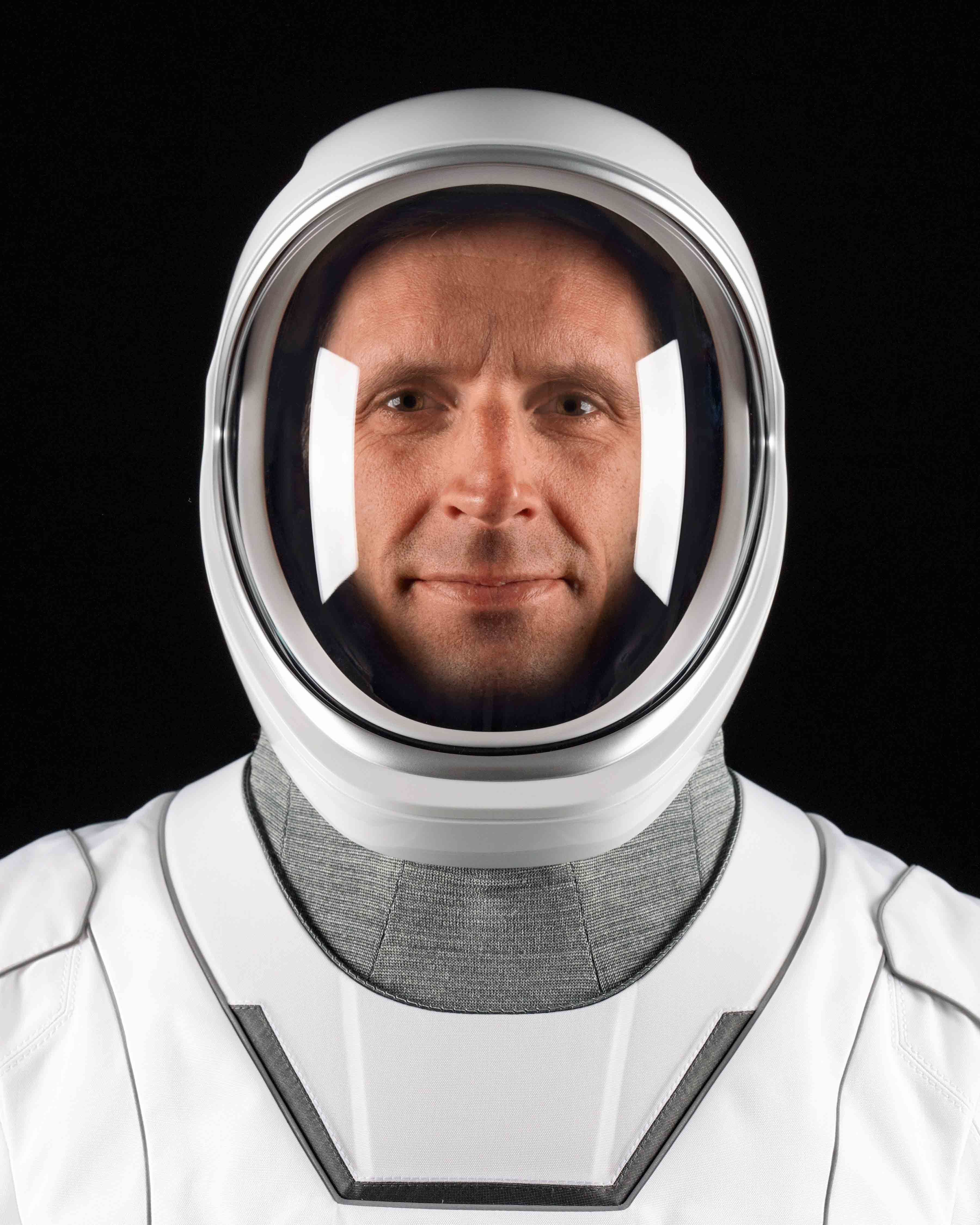
According to NASA and SpaceX, they are adjusting the launch date for Crew-13 to address an oxidizer leak in Dragon’s propulsion system, detected during standard prelaunch testing. “Joint NASA and SpaceX teams are performing additional tests and data review and will complete any necessary rework before launch,” says NASA. “A new target date will be announced once available.”
The sprawling campus is by no means the only facility for astronaut training, but it is arguably the most famous government facility for astronaut training in the United States. After astronaut candidates are selected, they spend a while at their home base (JSC, in the case of Americans) to learn the fundamentals of agency work, as well as engineering and science.
But the work rapidly ramps up to facility training here at JSC, as well as at facilities around the world (Europe, Canada, Japan and Russia among them) — with perhaps some time at commercial training facilities, particularly at SpaceX.
“Basic training also builds astronautic skills that are required for specific tasks on the ISS such as extravehicular activities [or] spacewalks, robotics, spacecraft rendezvous and docking. Russian language, human behaviour and performance training as well as survival skills round off the basic training,” the European Space Agency says of the basic work.
With limited time available to my media group, we focused on three zones at JSC: Mission Control (where astronauts serve as capcoms, or capsule communicators); Building 9 (also known as the Space Vehicle Mockup Facility) and the Neutral Buoyancy Laboratory (where astronauts train for spacewalks in a large pool)
Mission Control: Capcomming
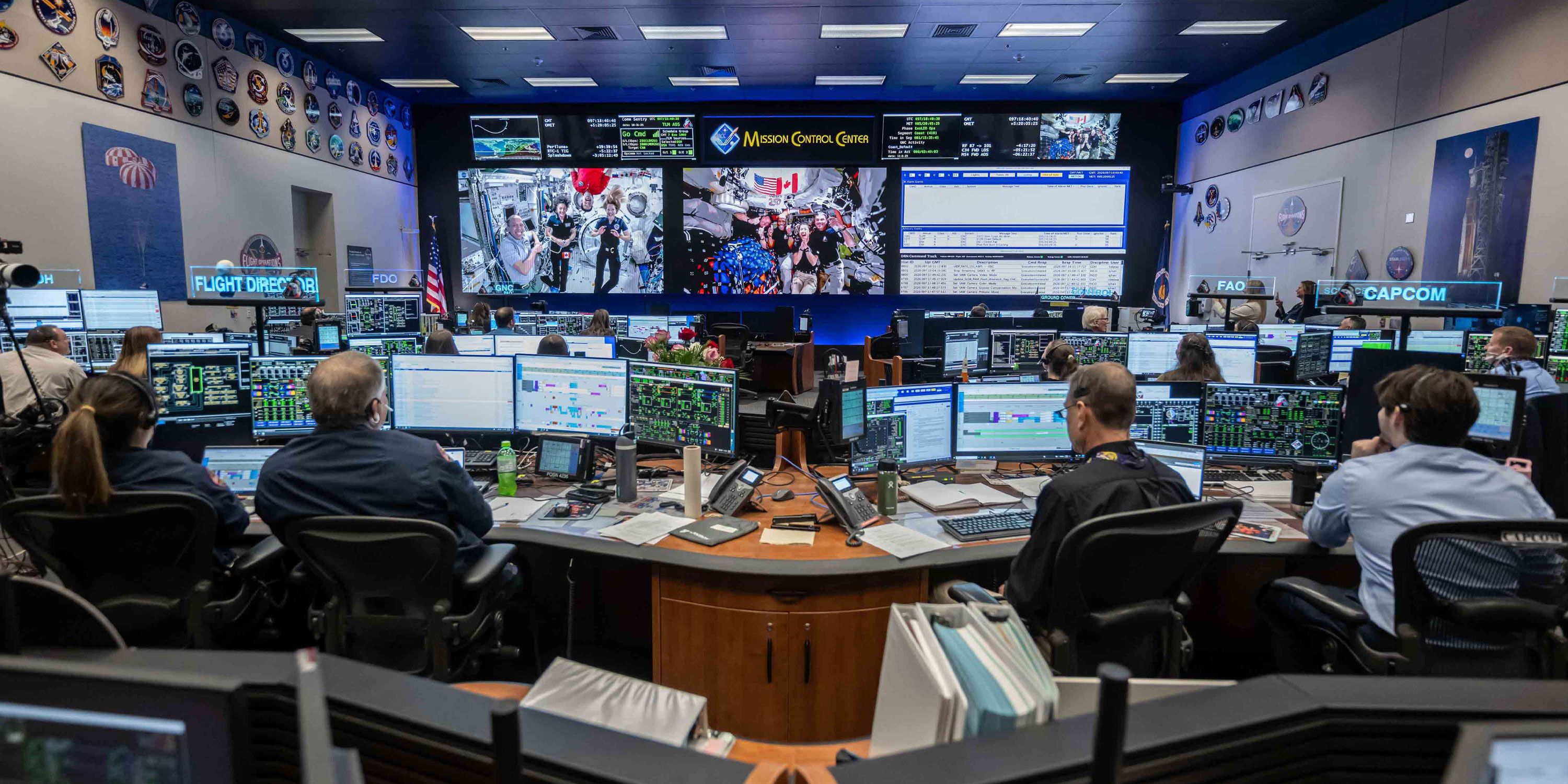
Our stop in Building 30 — the Mission Control Center with different rooms for different missions, including Apollo — was the ISS hub. From a glassed-in viewing room, we watched controllers work on a quiet Tuesday morning, interacting with the crew on matters such as experiments and getting ready for a solar-array-mod spacewalk two days hence, on August 6th.
Guiding us through the room was Diane Dailey, a NASA flight director with 20 years under her belt in Mission Control. “The number of people in this room really flexes with whatever activities we have going on,” she said. During the EVA, she noted, “this room will be packed, not just with the prime controllers that are on console, but we usually have people that are watching as well. We call it on-the-job training.”
Dailey began as an Environmental Control and Life Support Systems flight controller, racking up 1,700 hours at that station (the equivalent of 212 eight-hour days) — including during the space shuttle program. In other positions, she also served on console for milestone missions such as SpaceX’s Demo-2 (the first Crew Dragon astronaut test mission) in 2020. She was promoted to flight director in 2021 and was at the helm on June 5th this year, when astronauts took shelter in a SpaceX Crew Dragon, during a discussion of repairing a long-standing leak on the Russian side of the station.
“We did not like the repair technique that they [Roscosmos] were entertaining, and so we decided to ‘safe haven’”, Dailey said — that’s bringing the crew to a more stable area of the space station while figuring out what to do next. She added that her challenge was not only the inherent safety of the crew, but also figuring out items such as supplies — what they would need in there immediately and if they were to undock, what to bring with them.
Once Roscosmos and NASA agreed on a solution for the leak, the astronauts emerged into a different issue: “The whole day got changed,” Dailey pointed out, due to the time the crew spent in Dragon. Experiments and maintenance had to be shifted, and each of those alterations had to be considered against an already-tight space station schedule, meaning that changes to that single day could have had impacts weeks down the road.
“That was a crew-safety concern, and that was absolutely the right thing to do,” she said, but added that the reshuffling of the schedule illustrates how what could be a normal day may turn into “sort of the things that you can’t anticipate.” But that’s a part of the flight director’s job, “to make sure they are executing the timeline — that we're looking ahead, not just what's happening today, but what's going to be happening in subsequent days.”
Often, the voice of those decisions is relayed, via the capcom station, to the orbiting crew by astronauts themselves.
Dailey said capcom is a little more fun, especially as you get to talk to the crew, but the entire room recognizes that the tone of that voice and the way of relaying the instructions is very important.
A typical capcom will need three to six months of dedicated training, the Canadian Space Agency points out on their website, and astronauts will serve numerous shifts in that chair to learn the rhythms of orbital operations from the ground — sometimes many years before they fly into space themselves.
The astronauts do simulations in a mock control room, figure out what to do if emergencies happen, and get a precise understanding of how mission-control centers around the world operate (as there are teams in Russia, Europe, and sometimes even in Canada if robotics are involved)
“Capcoms must choose their words carefully and be clear and concise for a few reasons: Time is of the essence during space missions, especially in emergencies. There is no room for error or interpretation,” the CSA writes. “In a sense, a capcom's communications are like verbal tweets, transmitting very complex information in a simple manner.”
Dailey, mindful of the Canadian media in the room, in particular praised the Canadian astronauts she has worked alongside — which has included Kutryk as well as Artemis 2’s Jeremy Hansen. Much like herself, they are flexible operators, and that is something she is reminded of by her personal mission badge.
When she became a flight director, Dailey chose “Horizon Flight” as her team name, in part due to that flexible thinking: “It embodies, in spaceflight, a lot of times we face a lot of challenges, right? The setback to schedules, things that don't go well. I loved the inherent idea of resilience. The idea of, like, let's press through the dark night, knowing there's light on the horizon.”
Looking forward, Dailey said that she is learning from working with SpaceX — which has its own mission control — that every organization has its own culture. NASA, learning from its earliest days and from foundational flight director Chris Kraft, has prioritized hierarchy and chain of command, with clear roles and responsibilities for each person. (The astronauts like that too, especially the military ones.)
“So when we get into the flights with the commercial providers, understanding what's our role, right? Like, what level of authority — do we or don't — we have over those operations,” she pointed out. And a lot of it comes down to long pre-mission conversations that end up with new procedures, so that no chain-of-command surprises come up during dynamic operations like when a SpaceX Crew Dragon is on approach to the ISS.
Others come down to good training in recognition of cultural differences.
SpaceX likes to gather large crowds within shouting distance of their own mission controllers in Hawthorne, California, to cheer on launching spacecraft, and the astronauts on board. So how do you train for that? “They have a giant speaker in the back that when they do the simulation, they turn that speaker on, and it's got all the cheering,” Dailey said. That way, flight controllers get used to working with the noise and how to raise their voices above it.
As for the future of the ISS, the biggest way its lifetime affects Dailey (and astronauts) at this time is conversations about when to engage in preventative maintenance, or when to “just focus on getting things done.” The ISS is currently expected to retire in 2030, but if Congress directs an extension, that would affect how Mission Control — and its capcom team, including astronauts — in turn direct the crews in orbit on their activities on maintenance.
Building 9: Mockup City
The challenge with touring Building 9 is that there is so much of it to absorb, and it changes substantially when I come by every few years. It is filled with simulators, sometimes with these mockups switching out in the time span of a single weekend. But look over decades, and you can see more subtle shifts.
In 2008, my first time on the floor, I was lucky enough to clamber around a space-shuttle trainer, in which I learned how to use the (complicated) toilet. That simulator is long gone, of course, but the ISS modules are still on the floor from back then — providing astronauts a sense of the physical space they have available to run experiments and to perform emergency training.
Support Supercluster
Your support makes the Astronaut Database and Launch Tracker possible, and keeps all Supercluster content free.
SupportIt appears, from a visitor’s standpoint at least, that NASA prioritizes active simulator missions on that floor and will rotate those simulators in and out as needed. For example, during my last visit in 2024, I visited the Boeing Starliner spacecraft ahead of Crew Flight Test-1, a demo flight to the space station. Starliner’s human missions are now on pause after that test uncovered numerous issues, but my tour this August showed the Orion spacecraft for Artemis missions is quite prominently visible — no surprise given Artemis 3 is launching next year, and two more in 2028, if the schedule holds.
There are also quite a few commercial mockups scattered about from entities like Starlab Space and SpaceX, showing the growing role that companies are playing in ISS operations — and the next-generation Commercial LEO Destinations program expected to replace ISS in the 2030s.
That’s the big overview, but what are astronauts actually learning here?
Focusing back on the ISS — because that is what most astronauts continue to train on these days — there are a few major things that crews learn about.
There’s emergency training, meaning fires, depressurization, medical incidents and other situations in which minutes can count. It was useful quite recently; earlier this year, NASA astronaut Mike Fincke found himself suddenly unable to speak in space; he recovered rapidly, and NASA did not need to return to the crew within hours to Earth, as was possible (although the agency still brought the crew home early for medical follow-ups).
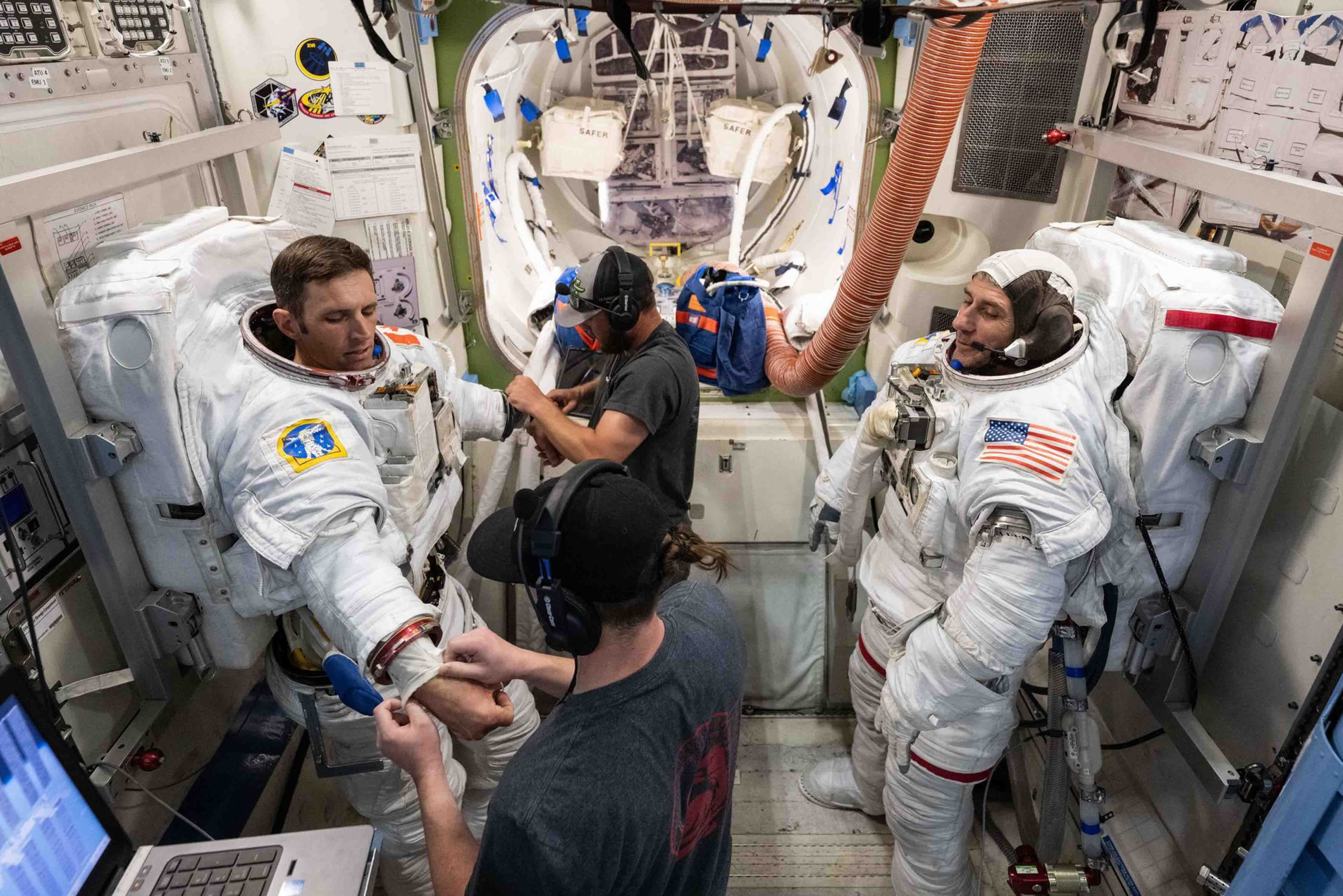
As the crew worked on the issue, the astronauts would have drawn upon what they learned here, in Building 9 — where all emergency training is performed, besides the discussions in classrooms. The astronauts learn about the equipment, the procedures and the communications, including how these differ on the U.S. and Russian sides of the station.
“Part of that [difference] is just because of the way they were built,” Kathy Bolt, chief training officer at NASA, said in a 2020 podcast. “Like fire response on the U.S. side, the crew leaves the segment, and they don’t fight the fire initially, because the U.S. segment is designed to put the fire out. It’s very compartmented, little sections — and once you burn all the oxygen in that one little section, it should put itself out, so it shouldn’t propagate; at least that’s the design. And so, our firefighting philosophy takes that into account.”
The astronauts also learn how to operate ISS airlocks with bulky spacesuits, and work alongside crew part-task trainers that show the intricacies of a particular flight system or subsystem — everything from an experiment to the rehydrating station where astronauts learn how to prepare food. (Even more complicated systems, like the Canadarm2 robotic arm on station, have their own facilities separate from Building 9).
Astronauts are already well-trained in how to follow the instructions even before arriving, particularly those who are military pilots or (like Artemis 2’s Christina Koch) former researchers in very isolated environments like Antarctica, where inattention or misdirection can make a moment’s difference between life and death. But the goal is to have the astronauts thinking in terms of NASA’s procedures, whether a situation is nominal or off-nominal, and what to do next if something can’t be found in the book.
Neutral Buoyancy Laboratory: Spacewalking in Water
Our last stop was the Neutral Buoyancy Laboratory, which is a place of superlatives — a 6.2-million-gallon pool so large that you can fit much of the ISS simulator modules in there without nearly filling the whole thing. If you can somehow imagine how large nine Olympic-sized pools could be, that’s the size.
But like seeing the Mona Lisa in person, it’s a privilege to be there live.
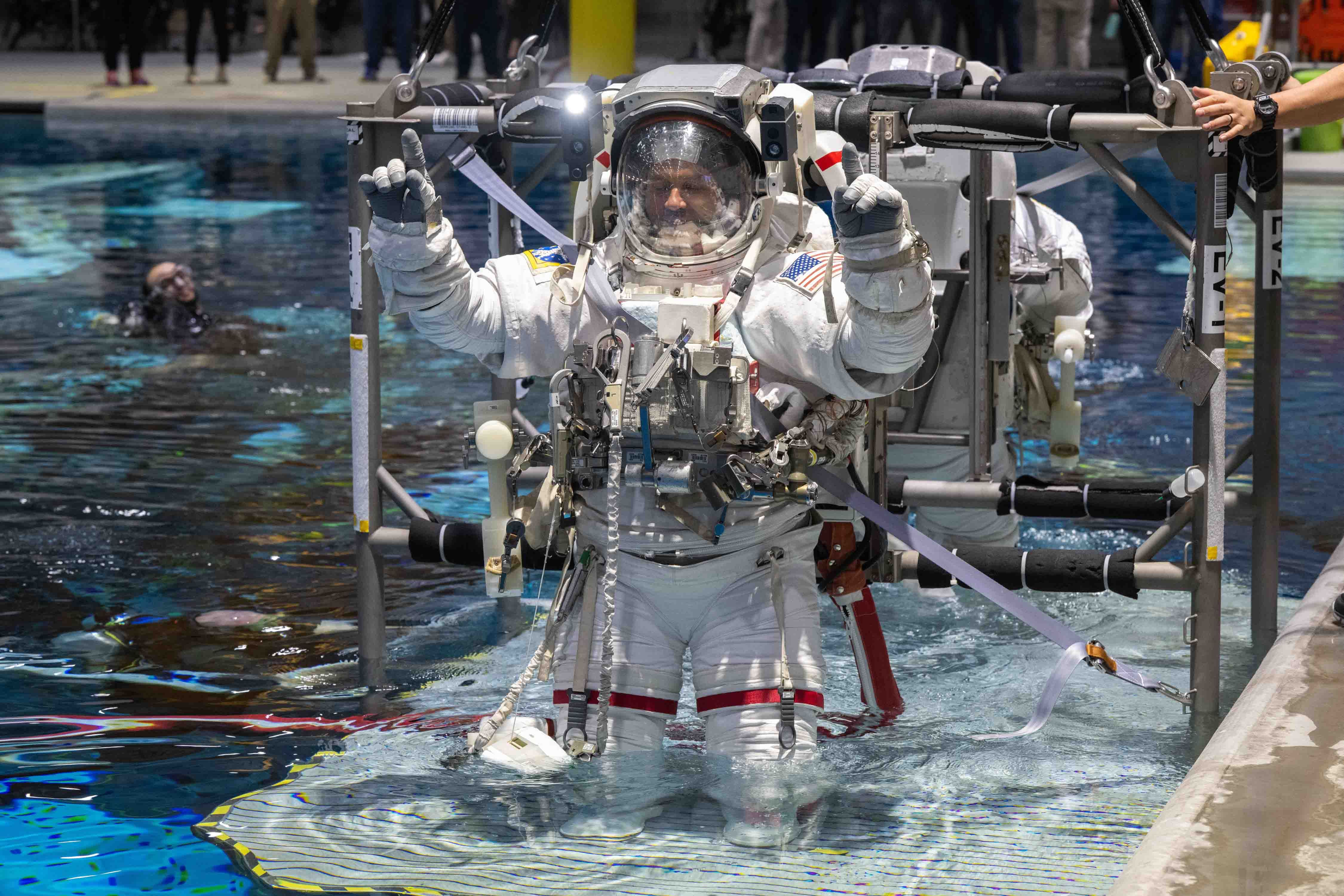
I take in the rows of divers getting ready at poolside, then mount the catwalk to watch two astronauts — ESA’s Raphaël Liégeois and NASA’s Deniz Burnham, expected to fly to space on their first missions in 2026 and 2027, respectively.
Liégeois and Burnham are practicing doing planned upgrades to the Alpha Magnetic (AMS) Spectrometer, we are told. AMS is a dark-matter hunter on the space station. I find it meaningful to watch, as a Canadian, because none other than Hansen was involved in 2019-20 repairs to the facility by helping design the tools and spacewalk procedures, for a facility never before anticipated to be repaired by astronauts.
And here are new EVAs on AMS being practiced, right in front of my eyes. It is hard to keep track of the crew from the surface, admittedly. The astronauts’ white spacesuits are barely visible on the white space station modules, especially given the bubbles disrupting the surface, but it’s easier to spot the black-clad divers helping them out.
“Each one of those crew members will have four divers at least,” says Tim Hall, who has worked much of his career in various roles at the facility. Roughly 30 to 40 divers are active at a given time in the NBL scheduling tool.
Divers work two shifts to support the astronauts in training, who will be expected in orbit to do spacewalks of at least six hours on a typical day. “We’ll have anywhere from 10 to 12 hours in the water during the full run,” Hall said.
While the water is a warm 87 or 88 degrees Fahrenheit, after about three hours a typical person will feel the 10-degree-difference from their body temperature and start to get cold. Divers will wear wetsuits to compensate, but crew switches are essential midway through a run for simple safety reasons.
Atop the facility is a mini-mission-control of sorts, called the test-conductor room, with multiple camera views that Hall called “a fly in the pool”, as it allows for images of what the crew is working on. Four or five cameras are operating at least during a typical run, including views of each crew member from up close.
Divers can hear instructions through underwater speakers, allowing them to adjust camera views as required. Some of the cameras are for situational awareness so that everyone knows where the crews are, while the close-up views help training teams see how the astronauts are performing on their tasks. “Are they manipulating the tools right? Are they in the right body positions? That's a big concern,” Hall said.
After completing basic EVA training during astronaut-candidate training, astronauts assigned to a typical six-month space station flight will complete a series of at least nine more EVA training runs, Hall said. Each run is about six or seven hours long, so a mission would require roughly 60 hours in the pool.
“They'll get in the suit, you know, at 8:30, and get out of the suit at 3:30, 4. So it's a long day. Part of that, too, is to train them that this is a very difficult thing to do. It's very taxing, and they get a liter and a half of water. That's it,” Hall said, noting that the lack of food (no lunch is offered) and water is meant to simulate what a day in a real-life spacewalk would be like.
And to be sure, no actual spacewalk is guaranteed; that would depend on if something needs fixing, if time is available in the crew schedule, and other matters at the mission-management level. As spacewalking time is so limited, Hall said sometimes he would hear about management requests to add just one more thing at maybe the five-hour mark.
His response typically would be something like, “Okay, we're going to put you on a treadmill and have you run on that treadmill for six hours, and then come to you at the end of the six hours, and only give you a liter and half of water and go, ‘By the way, can you give me another two hours, or hour and a half?”
The real-life spacewalks also have another element of sensitivity: the entire thing is televised, and astronauts do want to do well for their public. So the NBL forms a crucial part of helping the astronauts learn their limits, and for controllers to understand when astronauts are “done” for the day and politely refusing, as the responses will depend on a person’s temperament.
Knowing how hard that work is, the trainers are impressed with their astro-students. “I would be so angry by the time I got out of that suit: ‘Give me some food!’” Hall joked. “People used to ask, ‘Did you want to be an astronaut?’ No, I don't. I like working at the Mission Control Center, having feet on the ground, so I'll let them do it.”
And that is all referring to a good day in space.
A bad day’s example would be the 2013 incident in which a water incursion in ESA astronaut Luca Parmitano’s NASA spacesuit quickly escalated into a situation where the water covered the back of his head, then began drifting around to his nose and mouth.
The crew did everything right that day, said Hall (backing up the findings of NASA’s official investigation, aiming to stop that from happening again). Luckily, Parmitano is a trained military pilot and, famously, his heartbeat barely budged from normal despite the stress. NASA’s Chris Cassidy, luckily one of the most experienced spacewalkers of the era and a former Navy SEAL, happened to be his outside crewmate that day.
While many lessons learned were implemented at NASA and in spacewalk training, one of note was helping crew members understand the difference between spacesuits in the US and Russia.
As Parmitano was brought back into the airlock, Hall said, a Russian crew member suggested popping off the glove first to help him get out of the suit. “If you do that, you can take his nose off; the helmet will shoot off because it's a high pressure.” While NASA crew members quickly corrected the error, Russian crew members are now trained on how to safely undo a U.S. spacesuit even if they are not expected to operate it.
Spacewalking trainers also implemented new procedures that Parmitano and Cassidy came up with on the fly, which saved precious moments during their journey back to the airlock. For example, Parmitano — who had difficulty seeing because of the water — gently let go of his grip on the station every so often to use his safety tether as an impromptu navigation device back to the airlock. In his suit, the astronaut was 300 pounds, generating enough of a gentle pull to help him understand in which direction the airlock lay.
“He made his way back to the airlock every time, letting go of the station every few feet and figuring out exactly where to go. That's legend,” Hall said.
While astronauts will not do so in nominal circumstances, as you always want to keep a grip on the hardware, in an emergency, it’s a possible procedure. Additionally, today’s astronauts use hand signals that Cassidy and Parmitano together developed in the airlock during repressurization; as Parmitano couldn’t speak, they came up with something like one squeeze meaning a yes, and two squeezes meaning a no.
Today, however, is a nominal end-of-run training session, and speaking of needing food and water, we journalists on tour are ushered out of the facility so that we can seek out lunch. Houston is blazing hot, as always, and I briefly consider what it would be like wearing a spacesuit in this weather. Worse than a snowsuit, I’m sure.
NASA’s training facilities are intended to evolve as the program does, and in fact, they’ve had decades of that adaptation already. While the key lessons learned are linked all the way back to Mercury, changes in technology, management studies, worker makeup, and commercial partnerships have propelled the agency into changes in how they approach astronaut training.
Post-ISS, I wonder exactly what all of this will look like — but there’s still at least three years and change to go before that happens, I realize. That’s enough time for many more runs in the pool, thousands of hours in the ISS mission control, and emergency training in the modules in Building 9. And like a current, that approach will energize the next generation of human space missions — no matter their destination.