Source Image Credit: NASA/ESA
Is Jupiter’s icy moon actually a water-pluming world, or were years of Hubble observations showing us something else?
A new paper suggests far less confidence in Hubble’s detections of icy-water plumes, which astronomers have been suggesting for more than a decade. The paper, published in May in Astronomy & Astrophysics, reanalyzed Hubble observations of Europa in 1999 and between 2012 and 2020, using the telescope’s Space Telescope Imaging Spectrograph (STIS).
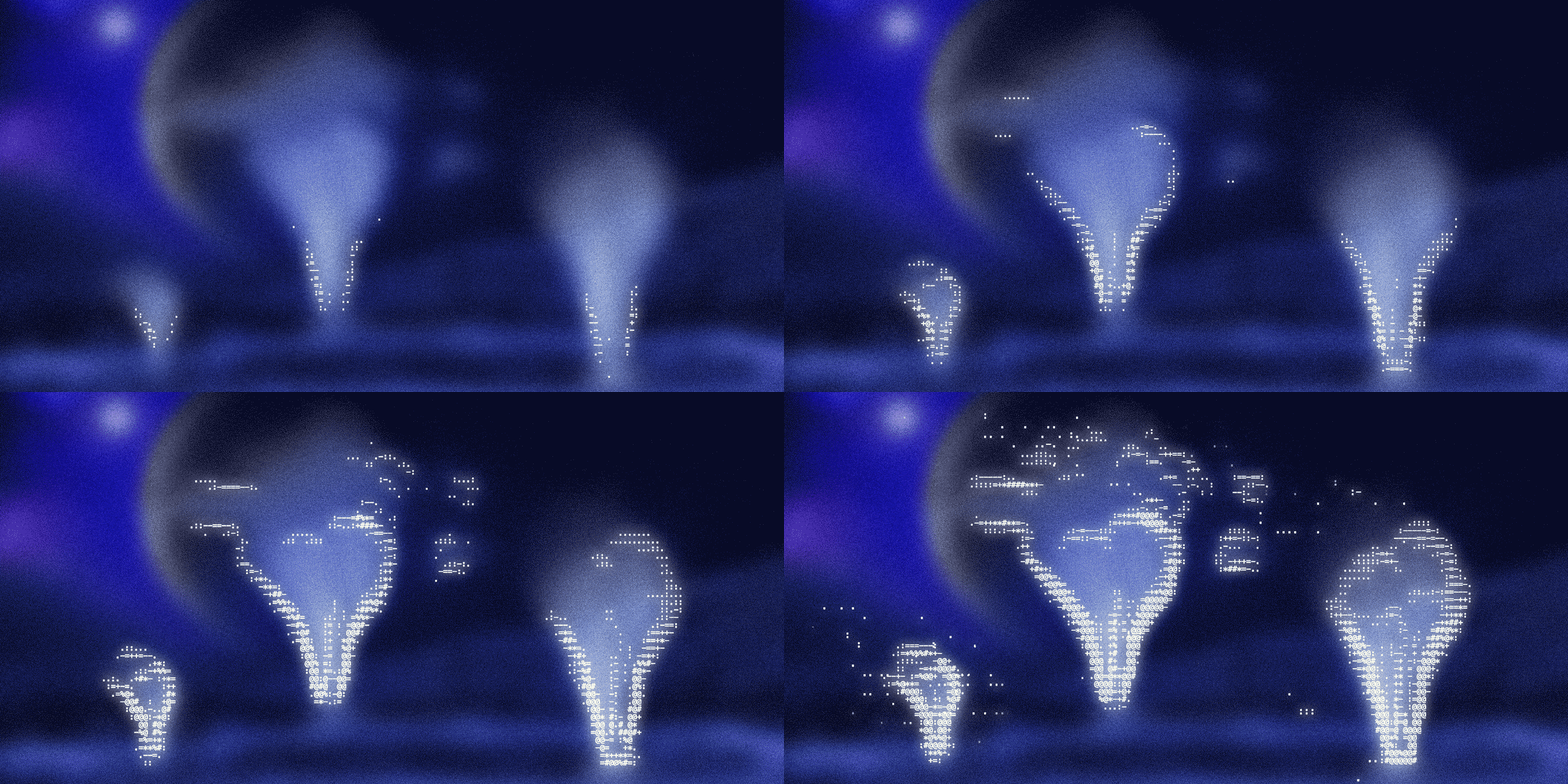
The spectrograph is optimized to analyze light (including ultraviolet light) to determine an object’s chemistry, temperature, and motion. The team examined Europa’s Lyman-α emissions, which represent a wavelength of ultraviolet light that hydrogen atoms scatter.
The signature of hydrogen pops up over and over again in STIS observations of Europa, but hydrogen does not necessarily imply water, Kent Retherford, a Southwest Research Institute scientist who was co-author on the new paper, told Supercluster.
Hubble, though a highly capable telescope that has rewritten our understanding of the universe, has always been working hard to see Europa, a small moon, roughly 484 million miles (778 million kilometers) from Hubble’s low-Earth-orbit trajectory. Europa is so small in Hubble’s viewfinder that there is uncertainty about where the moon is exactly in the image (down to the pixel, which can affect observations). Also, Hubble is constantly orbiting Earth, meaning that Europa is not visible during the entire observation period because our planet is in the way.
The team found that the plume emissions were “attenuated” when taking into account wisps of Earth’s atmosphere above our planet, especially when Europa’s radial velocity and Doppler shift are low relative to Earth.
What this means is the probability of water plumes spouting from Europa drops considerably, from 99.9% confidence to less than 90%.
For comparison, when the Higgs boson particle was discovered in 2012, scientists at the time only accepted its existence at the higher of these standards, which is a crucial threshold for scientific discovery known as “five sigma”; sigma represents a standard deviation in the data, and a higher sigma level implies a higher level of confidence. Lower sigma levels don’t necessarily imply an issue, but indicate that scientists are not (statistically speaking) confident in the result.
The new paper on Europa plumes says more data is needed.
“We were really excited about the initial evidence for water vapor plumes on Europa, but we always did say this is a measurement that needs confirmation,” Retherford told Supercluster. “We went about and made more measurements, and that provided us with enough of a statistical analysis to go do what we did next … That's the scientific method, and we've done our best to stick with that in the spirit of things. A little disappointing that the evidence isn't there, and isn't as strong as it was, but also we try to keep a cool head about it.”
Luckily, there’s a new mission devoted to Europa and it's already on the way there. Clipper may be able to spot what’s going on with the moon. One scientist expresses hope that Europa Clipper can increase the statistical significance of plume detection.
“I think what it tells us is that Europa is complicated, the Jupiter system is complicated, these types of observations are complicated,”
Amanda Hendrix, CEO of the Planetary Science Institute and whose scientific specialty is UV observations of worlds like Europa, told Supercluster about the new study. “I think what it [the study] does is it makes everything all the more interesting,” she continued. “It makes me even more excited for Clipper to get there and to really understand what's happening at Europa.”
‘To its limits’
Europa was first spotted, likely independently, in 1610 by Florence’s (now Italy’s) Galileo Galilei and Bavaria’s (now Germany’s) Simon Marius. Europa is one of the four largest moons around Jupiter, just visible with the small telescopes that were cutting-edge tech at the time. Galileo wanted to name the moons after his patron, Cosimo II de’ Medici, although it was ultimately Marius’ suggestion of Io, Europa, Ganymede, and Callisto that scientists use today, on advice from the International Astronomical Union that arbitrates the naming of celestial objects.
We would have to wait nearly four centuries to see Europa up close, which happened in the early 1970s with NASA’s Pioneer 10 and 11 spacecraft, and then (in better resolution) in 1979 when NASA’s twin Voyager spacecraft flew through the outer solar system to take advantage of a rare alignment between Jupiter, Saturn, Uranus, and Neptune. Voyager 1 was too far away to see much that January, although it did spot intriguing lines crossing each other on the surface in a pattern very different from the craters we are used to on our own moon. The spacecraft also saw strange red material. Voyager 2’s flyby in July confirmed its twin’s observations, showing dark, red streaks suggesting “Europa’s crust had been fractured and filled by material oozing up from the interior,” NASA officials stated.
Source Image Credit: NASA/ESA
In 1989, the agency launched a spacecraft aimed at figuring out more: the Galileo mission to Jupiter and its moons, which ultimately flew by Europa a dozen times (sometimes much closer than others). As the mission was running, scientists found extensive evidence of changing ice on the surface and an ocean underneath, but it was only by analyzing the data in retrospect (after Galileo’s mission ended in 2003) that possible plumes began to pop out.
That’s because plumes weren’t part of the conversation until a surprise observation in December 2012 by Hubble. As described in Science Express by a team (including Retherford) the next year, the telescope spotted hydrogen Lyman-α and oxygen emissions above Europa’s southern hemisphere, suggesting water vapor shooting as high as 200 km above the surface. Scientists back then warned that the vapor, if actually there, appeared to be transient because Hubble didn’t spot the signature during a November 2012 observation.
One of the team members warned in a press release, Hubble’s Advanced Camera for Surveys was used “to its limits”, including by taking advantage of a recent instrument repair from a space shuttle mission in 2009, to see the activity. Follow-up observations by Hubble also suggested plumes in 2016 and 2017. The potential was exciting as only Enceladus, any icy moon of Jupiter, was known to be erupting in water plumes at that time. (The plumes at Enceladus have confirmation from a close-up view provided by the Cassini spacecraft, unlike the current situation with Europa.)
Plumes are not a direct smoking gun for life, but quickly put the implications sum up to this:
if moons like Europa and Enceladus have plumes and water oceans, that implies material between space and the ocean can interact.
This source of renewal is important to provide supplies for possible microbial life in these oceans. But many more steps must be taken before proving said life is possible, or there, including far-future surface missions to the moons.
Support Supercluster
Your support makes the Astronaut Database and Launch Tracker possible, and keeps all Supercluster content free.
SupportThe Europa plume observations by Hubble have generated counterpoints even before this latest reanalysis of Hubble’s data in 2026. Mid-infrared spectroscopy of Europa using the now-retired Stratospheric Observatory for Infrared Astronomy (SOFIA) spotted nothing in observations published in Astrophysical Journal Letters in 2019, with the authors noting that the airborne observatory did have the capabilities to see any water vibrational-rotational emission lines if Europa was erupting. But the authors were clearly aware that there is also the possibility that Europa is a transient erupting world, leaving hope that future observations could find something: “If plumes can be securely identified on Europa and quantitatively characterized, the implications will be profound,” they wrote.
Then, in a Science paper published in 2023, scientists reported that NASA’s newer and more sensitive James Webb Space Telescope (JWST) also found no evidence of plumes as of yet. That said, JWST’s work did imply the life-friendly element of carbon in Europa’s ocean, concentrated in a geologically young region of “chaos terrain” known as Tara Regio. JWST’s observation of carbon dioxide ice on Europa was made using the integral field unit of its Near-Infrared Spectrograph (NIRSpec). Since carbon dioxide wouldn’t stick around long on the surface of Europa, this implies there is a constant source of resupply, whether by a life process or not.
Seeing more would require a close-up mission, however. The US scientific community identified developing a Jupiter Europa Orbiter as the second-highest priority for the 2013 to 2022 Astronomy and Astrophysics Decadal Survey, which is jointly led by the National Research Council and the National Academy of Sciences.
“Because of this ocean’s potential suitability for life, Europa is one of the most important targets in all of planetary science,” the decadal authors stated, but added it would be best to “descope” the mission due to NASA budgetary realities. The result is Europa Clipper, which will look at the moon via a series of flybys. The mission was first funded in 2015 and is projected by the Planetary Society to cost $5.2 billion altogether through the expected end of its mission, in 2030.
Source Image Credit: NASA/ESA
Discoveries in The Deep
Clipper's main science objectives aim to bring more clarity to long-standing, difficult questions about this icy world: how thick is that ocean shell, and does any material from the surface go down into the deep? What is inside the ocean, and could it sustain life? And can we spot any geologic signs of recent activity, such as plumes or changes in the surface blocks of ice?
That latter question is especially thorny and important, because some of it relies on interpretations of lower-resolution images (considered state of the art in the day) from the Galileo mission. A 2014 study in Nature Geoscience, for example, suggested that about 7,700 square miles (20,000 square kilometers) of Europa’s surface ice was subducted, or moved under, a second icy plate—similar, but not the same, to Earth's plate tectonics. While this process is not a direct smoking gun for plumes, it does support the idea that Europa has a young surface, which would be helpful to explain the plumes because geological youth implies more surface activity and renewal.
Clipper launched from NASA’s Kennedy Space Center on October 14th, 2024 aboard a Falcon Heavy rocket. The spacecraft has been active, although it will not reach its destination until April 2030. NASA did use the Europa Ultraviolet Spectrograph to observe interstellar comet 3I/ATLAS in November 2025, in a common repurposing of astronomy instruments for a special event.
But look closely, and there’s more to the comet observation. Clipper worked together with the European Space Agency (ESA) spacecraft’s own large-scale spacecraft called Juice, Jupiter Icy Moons Explorer, which has a broader scope to examine Europa, Callisto, Ganymede, and Jupiter in the 2030s. SWRI, which is involved in both missions, “informally” coordinated observations between the two spacecraft and spotted hydrogen, oxygen, and carbon—the ingredients of life. Not only that, but the two spacecraft working together provided the first view of escaping gas of any comet’s coma, in two directions: the night side with Clipper, and the day side with Juice.
This is not only valuable science. It’s also valuable target practice.
Retherford is involved in the new Europa-plume study and is the principal investigator of both Clipper’s ultraviolet spectrograph and Juice’s ultraviolet spectrograph. He anticipates the two missions will work together again, at least a couple of times, to perform the first-ever deep-space simultaneous observations of Europa in the 2030s. The opportunity is huge: two expensive spacecraft, far from home, able to look at an icy moon to watch for eruptions and to learn more about what lies underneath.
“We do have two flybys of Europa planned with Juice, and certainly the Juice team is really excited about having a slightly different set of instruments,” Retherford explained. There is a hope that Clipper and Juice can perform flybys that are “pretty closely spaced in time, like four hours apart from each other”, allowing for the first-ever coordinated Europa observations from close-up.
The UV instruments between the two missions are almost identical in terms of their wavelength optimization, Retherford explained, but the composition of complementary instruments differs. Clipper has a dust instrument, unlike Juice, but ESA’s mission has more instruments designed to measure Europa’s plasma environment and magnetic fields compared with Clipper.
The coordinated flybys, therefore, “can complement our understanding of certainly, the induced currents within Europa's oceans that propagate out into space and then form the magnetic fields that we can study, with different plasmas trapped on those field lines in the environment around Europa. That's something that Juice has more instruments dedicated to, more sensor heads, and so the two data sets combined will complement each other for sure.”
In the week before the Supercluster interview, which took place in late May, Retherford was speaking with other Juice investigators about slightly tweaking their Europa flyby to cover a ground track that, if all goes to plan, will already have been traversed by Clipper. This will allow investigators to look at the same area at slightly different times of day, and with complementary instruments, providing unprecedented high-definition looks at some regions of Europa. “We're trying to get as clever as we can to optimize that partnership between the two missions,” Retherford said.
But first, Clipper needs to get to Europa. The mission is expected to make its Jupiter orbit insertion in April 2030 by firing its engines for six hours, with a minimum of help from Earth because our planet is too far away to steer the spacecraft in real time. That insertion will also include a flyby of Ganymede, another icy moon of the system. Assuming all goes well, it will take until 2031 for Clipper to finalize its orbit through multiple flybys of Jovian moons, including the first of Europa in spring 2031.
The observation campaign at Europa is expected to be extensive and scientifically exciting: Clipper is expected to fly by as low as 16 miles (25 kilometers) from the moon’s surface, gathering information on the possible ocean, the ice, the atmosphere, and, if present, any plumes. At the very least, knowing that the mission will fly by Europa repeatedly is a boon for science, because unlike the limits of Hubble, Clipper will not only have high-resolution imagery of the surface and moon but also the aspect of repeatable observations from that close-up vantage point.
What’s more, Clipper’s mission will focus its flybys in two sets to chart the influence of Jupiter, the largest planet in the solar system, as well as the source of a huge well of radiation. Between about May 2031 and May 2033, the spacecraft will focus on the anti-Jovian side of Europa, or the side that faces away from the planet, until spending its last expected year of operations in 2033 and 2034 on the sub-Jovian or planet-facing side. (The mission could go longer if the money and will are available, assuming it remains healthy.)
Clipper’s time at Europa will help scientists nail down whether there are indeed plumes, but even if it comes up empty in that respect, PSI’s Hendrix said the mission will be valuable to the community. “It's just really, absolutely fascinating to go to this body that is relatively young and has a subsurface ocean, you know, and Clipper will go a long way to understanding whether that ocean is habitable,” she said.
From there, scientists can then make plans for future missions targeting icy moons that may also be habitable, including Europa. “It's not going to find life, not even really going to look for life,” Hendrix said of Clipper’s contribution to the search-for-life effort, “but it will be able to understand—by putting various data sets together—how habitable the ocean is, which is really exciting.”
Source Image Credit: NASA/ESA/K. Retherford/SWRI