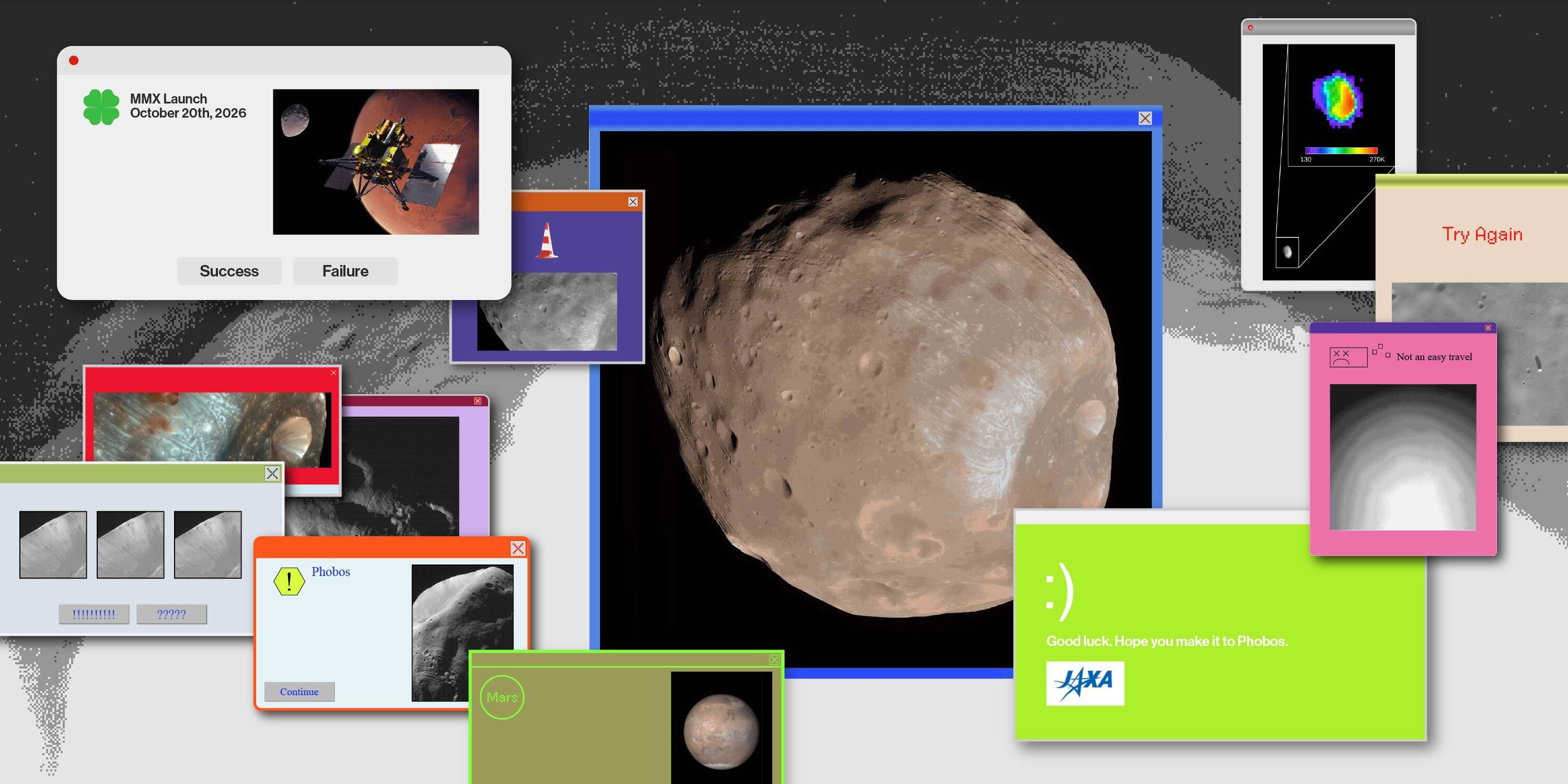
On October 20th, just shy of the pre-dawn twilight, a rocket took off from the southern Japanese island of Tanegashima.
On board was Japan’s Martian Moons eXploration (MMX) spacecraft, the boldest solar system mission JAXA (Japan’s NASA) has ever undertaken. Its plan? Fly to Mars, land on Phobos — one of its two peculiar moons — and grab some of its rocks using a vacuum cleaner and a bolt gun-like drill. Then it’s got to bring them back to Earth in 2031.
The goal? Find out where Phobos came from. Is it a shorn-off piece of Mars itself, or a captured asteroid or cometary interloper from far beyond?
Hopefully, as you read this, the alien moon burglar is still fully functional, and still on its way to Mars, happily cruising through interplanetary space. Japan is fantastic at what is known as sample return missions, those that visit other celestial bodies, extract some material, and bring those pristine treasures home to scientists on terra firma. In the last two decades, they have successfully carried out two of them — one to the asteroid Itokawa, and another to the asteroid Ryugu. MMX is a phenomenally capable spacecraft commanded by a hell of a team; there’s a decent chance the mission will triumph.
But there are no guarantees. Several nations have sent missions to Mars; over half of them failed. Prior to MMX, Japan has only sent one of its own to the Red Planet: Nozomi, an orbiter meant to investigate Mars’s faltering upper atmosphere. Although things got off to a good start, Nozomi was destined to miss its mark. First, a faulty valve leaked propellant. Then a potent solar flare caused some of its communications and power systems to malfunction. Eventually, the main thruster failed. Instead of ending up orbiting Mars, it settled into an endless circumnavigation of the Sun.
Few today doubt JAXA’s ability to reach Mars, especially with several extra decades of solar system exploration experience under its belt. But safely landing on Phobos will be phenomenally difficult. The moon is just 14 miles long, making it a very small target and one with featherweight gravity, not something that’s easy to cling to. And it orbits just 3,700 miles above the Martian surface, meaning it's deep inside the planet’s gravity well. MMX might just slip past its landing site and crash into the world below.
The scariest part, though, is that there is no precedent for what MMX is hoping to achieve. Over half of the missions to Mars have failed, sure — but every single mission to Phobos has prematurely perished. Phobos may not look particularly intimidating, but its name means ‘fear’ — an emotion acutely felt by Russia, which, prior to Japan, was the only country to attempt to reach it.
Support Supercluster
Your support makes the Astronaut Database and Launch Tracker possible, and keeps all Supercluster content free.
SupportThe year is 1988. The Soviet Union is marching toward its dramatic collapse, but still harboring hope of flying out to the stars. So, that summer, it launches Phobos 1 and 2, two robots aiming at the eponymous moon.
Both had a suite of instruments capable of examining Phobos from above, and each had a lander that would touch down on Phobos and stay put, investigating their surroundings from their new, permanent home. Phobos 2, though, was particularly cool: it also carried a ‘hopper’, a droid with spring-powered legs that would allow it to bounce across Phobos like a metallic frog.
Sadly, none of this glorious extravagance was meant to be.
Phobos 1 was, appropriately, the first to fall. In August 1988, about a month after being launched, a series of routine commands were being manually sent to it from mission headquarters, with each character having to be typed out manually. The ground controller on station at the time typed everything out perfectly — except for one single letter, which he accidentally omitted. The spacecraft received its ever-so-slightly wrong instructions and, upon reading them, initiated a dormant thruster test-firing sequence.
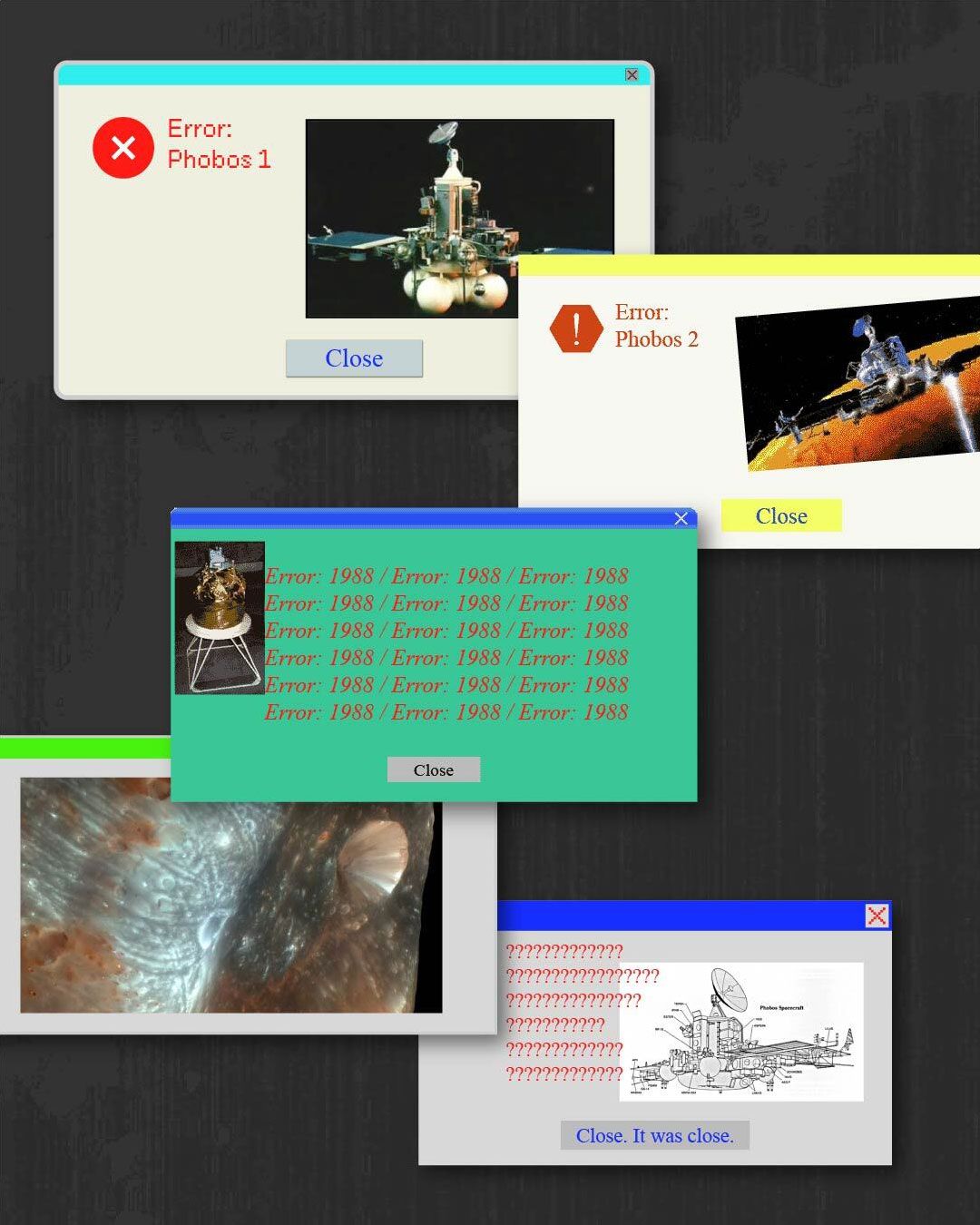
At first, nobody noticed. Two days went by. When mission control checked back in with Phobos 1, they discovered it was tumbling about wildly, like a spinning top that had fallen down a flight of stairs. Its fate was sealed: it was never going to be able to correct itself and make it to Mars. Naturally, the ground controller responsible expected to be the next thing propelled unceremoniously into space. It’s not clear what happened to him, although he was reportedly spared incarceration in a Siberian gulag.
Phobos 2 fared a little better, even making it to Martian space in early 1989 and taking actual photographs of Phobos as it zipped past. But just before it was due to deploy its two landers, error messages lit up dashboards in mission control. Its transmitter, which was temporarily shut off to conserve some power during the spacecraft’s imaging of Phobos, couldn’t be switched on again. A malfunctioning computer system meant that Phobos 2 also ended up in a terminal tumble.
Just after Christmas Day in 1991, the Soviet Union collapsed. Amid the chaos, few, if any, thought that trying to send a robot to a Martian moon was anything close to a priority.
Eventually, though, the Russian space program started to get some of its ships together. And in 2011, many of the nation’s solar system exploration hopes were placed squarely on the shoulders of the Phobos-Grunt mission — ‘grunt’ meaning soil. That’s right: Russia was going for broke, sweeping aside the failures of its Cold War-era dance partners and putting all its chips on a sample return quest. Phobos-Grunt was going to chase down its namesake, land on it, dig up some alien rocks, and bring them back to Earth.
Roscosmos, the Russian space agency, had reasons to be optimistic. It had learned from its past Phobos failures. It would check things more forensically. It had installed backup systems on its spacecraft in case key components failed. Phobos-Grunt was set up in such a way that, even if it could no longer communicate with mission control, it could automatically gather a sample, load it up, and launch it on an Earth return rocket. In other words, Roscosmos was ready for a win.
It blasted off into space on November 8th, 2011. Initially, everything looked good — but ground controllers felt a deep pit open in their stomachs when they realized the rockets meant to carry Phobos-Grunt deep into space and put it on course for Mars had not fired as planned. They tried, desperately, to trigger the sequence that would take their envoy beyond the firmament. Instead, the spacecraft ended up no further than 215 miles from Earth’s surface, which is a little below the average altitude of the International Space Station. After circling the planet for several weeks, it was consumed by fire in January 2012 when it plunged back into Earth’s atmosphere.
Three shots. All misses.
Space, as they say, is hard. But is Phobos cursed? All eyes are now on MMX. Next year, it’ll arrive at its destination. It will swing around Mars, then hunt down Phobos, chase it as it orbits the Red Planet, then try to land on it not once, but twice. Will there be jubilation at JAXA, or misery? Will there be commiserations, or congratulations?
If MMX succeeds, it will transform our understanding of Mars, its moons, and perhaps even the inner solar system. But if it fails, there is something we can all take comfort in. Phobos is, bit by bit, getting closer to Mars. In 50 to 100 million years, one of two things will happen: it will either be ripped to pieces by the planet’s gravity and turned into a dusty ring system, or it will smash into the Martian surface and be vaporized in the process. Serves it right, honestly.