
There have been movies about the moon as long as there have been movies. But the oldest moon movie has endured more than most.
In 1895, sibling technicians Auguste and Louis Lumière held the first-ever public exhibition of moving images with several minute-long projections of everyday occurrences. The 33 spectators among that initial audience included illusionist Georges Méliès, who was entranced. Over the next several years, Méliès would apply his craft to short films featuring primordial special effects, many of which were simply extensions of his stage presence. But his towering accomplishment was 1902’s A Trip to the Moon, a playful and creative short that set the bar high for moon movies right out of the gate.
While many early movies were adapting plays and novels, Méliès consolidated several sources that encapsulated lunar fiction of the time. The film drew from both Jules Verne’s 1865 From the Earth to the Moon and its 1870 sequel Around the Moon, as well as H.G. Wells’ 1901 The First Men in the Moon. Its loose plot revolves around a society of French scientists who launch a rocketship to the lunar surface, but its real star is the moon itself. Méliès (who is also a cartoonist) depicted his travelers crashing headlong onto a cratered face that winced at its new arrivals.
Nearly a century later, the Smashing Pumpkins resurrected that iconic moment in their video for “Tonight, Tonight.” By then, there had been several movies that envisioned the surface of the moon, but nothing that lingered in the public imagination as much as A Trip to the Moon.
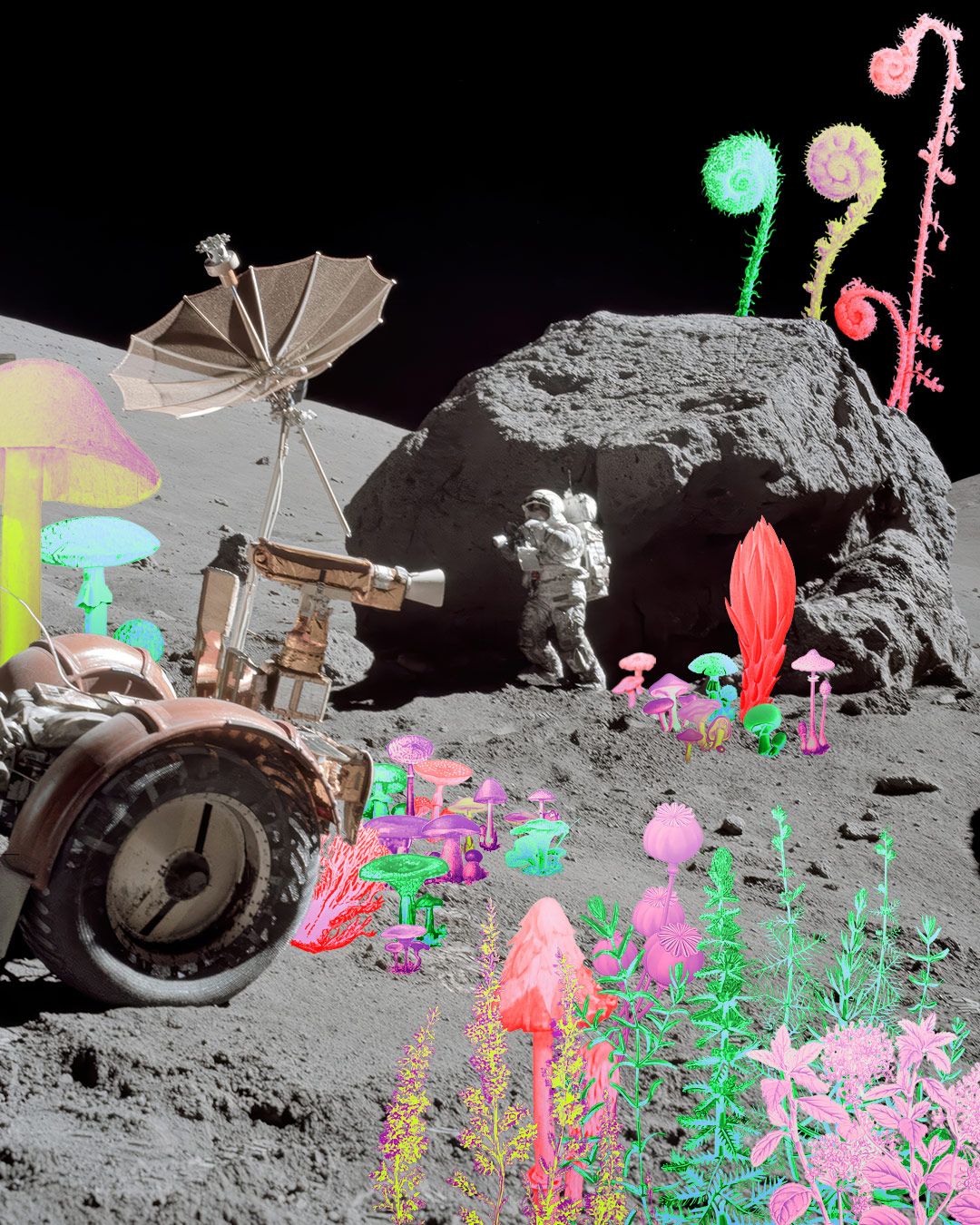
That’s partly because Méliès’ version of the moon was a vivid environment teeming with life, far different from the arid landscape that Apollo astronauts would bounce across decades later. His travelers encounter hostile species who kidnap the visitors and present them to their king. After a dramatic showdown, the crew makes its way back to Earth with an alien captive, who remains on display to the public. Méliès’ moon is much like James Cameron’s Pandora, the psychedelic planet of his Avatar movies: lush, intricate, loaded with mystery and danger, nothing like the “magnificent desolation” that Buzz Aldrin observed in 1969.
By then, the emptiness of the moon was already understood well enough to shift its cinematic form. It provided an ideal mood-setter early in Stanley Kubrick’s 2001: A Space Odyssey, when astronauts discover a monolith indicative of extraterrestrial presence beyond their comprehension. Set to the haunting choir of György Ligeti’s Lux Aeterna, Kubrick’s depiction of an empty white canvas was accurate enough (thanks in part to NASA advisors) to plant the seeds for a conspiracy that blossomed years later.
It took a little more than a decade for adherents of the Flat Earth Society to circulate the theory that Kubrick’s moon sequence in 2001 scored him a gig faking the Apollo 11 landing. More than that, the story goes, Kubrick felt so guilty about deceiving the public that he planted clues of his guilt in The Shining. While appalling to anyone with a basic respect for science and, well, facts, this outrageous revisionist view fueled the plot point of both 2016’s mockumentary Operation Avalanche (an underrated comedic thriller from the future director of Blackberry) and the Apple TV movie Fly Me to the Moon. These fictional works have less to do with the appeal of the moon in the popular imagination than the public’s inability to grasp the sheer technological sophistication necessary to get there. They deserve a separate category — the limits of the human mind, and its knee-jerk tendency to mythologize — beyond the canon of moon movies under consideration here.
Instead, post-Apollo, the most appealing lunar cinema looked much like what astronauts found there and mined it for narrative potential.
Duncan Jones’ underrated Sam Rockwell thriller Moon imagines a lonely clone attempting to make sense out of his isolated surroundings and the circumstances that brought him there. The Neil Armstrong biopic First Man positioned the first moon landing as a catharsis for Armstrong’s grief, and derives most of its power from the wordless expressions on Ryan Gosling’s face as he gazes out at an ancient, uninhabited plane. In 2019’s moody Ad Astra, the moon is both a bland tourist attraction and a waystation to Mars. It’s a bit busier, but marred by piracy and consumerist fantasies, no less inviting than it is today. The ongoing Apple TV series For All Mankind, with its revisionist history in which Russia gets to the moon first, maps out the strategic advantages (and potential conflicts) around the corner once all that open space gets colonized.
That’s the good stuff.
Since the moon lacks the secrecy of the early 1900s, more recent exaggerated visions of lunar life lack the creative energy of the Méliès film. The dopey Iron Sky franchise envisioned Nazis hiding on the dark side of the moon. Roland Emmerich’s inane misfire Moonfall imagined the moon as a giant alien superstructure. These projects come up short in large part because they don’t meet the moon on its own terms as we now understand them.
Support Supercluster
Your support makes the Astronaut Database and Launch Tracker possible, and keeps all Supercluster content free.
SupportWhich brings us back to Méliès. Why would an early filmmaker turn his lens to the moon? Part of it stems from the way the moon embodies the awe and mystery of human existence. It’s both familiar and alien, close enough to admire but too far to know. The resilience of moon movies also comes from the inherent and lasting relationship between cinema and stargazing. Both require looking at light reflected from the past. Telescopes are actually time machines.
We never see the moon exactly as it is before us.
It’s the ultimate primal form of cinema, a spectacular show on display every night, free of charge.
....
Eric Kohn is the artistic director of the Southampton Playhouse, overseeing its programming initiatives throughout the year and writing its weekly newsletter, The Playhouse Post. He brings nearly 20 years of experience as a journalist at IndieWire, the entertainment trade publication, where he served as Chief Film Critic, Senior Editor, and Vice President of Editorial Strategy. While there, he co-hosted the popular movie podcast "Screen Talk" with Anne Thompson, in addition to covering Sundance, Cannes, the Oscars, and more. His writing has also appeared in The Hollywood Reporter, The New York Times, and other publications. A two-time chair of the New York Film Critics Circle, Kohn co-founded the Critics Academy initiative, a workshop for aspiring entertainment writers. Since 2013, he has served as an adjunct professor of cinema studies at New York University. He also produces feature films, including several recent projects with Harmony Korine. His favorite movies include Breathless, F for Fake, The Night of the Hunter, and anything directed by Agnes Varda or Ernst Lubitsch.